| Science is not about describing |
Mathemagix is the 'science' of description Since Galileo and Newton, the misconception has grown that science is about describing the results of experiments mathematically. Emeritus Professor Donald Simanek synthesizes: .........."Science doesn't explain; science describes." (Italics added by Simanek for emphasis) This pretty much synthesizes what all people coming out of college have been taught to repeat by rote. The notion has been taken to ridiculous limits where contemporary researchers are solely interested in finding equations to synthesize their observations in order to collect a Nobel Medal. The quest is no longer to understand how this Universe works. The quest is to describe mathematically and become a celebrity. This is the appalling state of so-called 'science' today. Here we will use lower case 'science' to refer to this anachronistic, 17th Century tradition of describing and capitalized 'Science' to refer to genuine Science: rational explanations. Because the members of the Math Club are into descriptions and only provide irrational explanations to natural phenomena such as gravity and electromagnetism, we will refer to them as mathemagicians. |
So? What's wrong with descriptions, especially, with mathematical descriptions? Why aren't they a part of Science? Let's illustrate the problem with a couple of examples to make it crystal clear. ..........1. We create a couple of standards: the meter and the second. We measure and ..............conclude that based on these standards, the Earth travels 30 kilometers per ..............second around the Sun. We have a description, a mathematical description. ..............What have we learned about the cause of gravity? What prevents the Earth ..............from drifting out of the Solar System? ..........2. We let go of a pen and discover that it always falls to the floor. We measure ..............and determine that it's acceleration is always 9.8 meters per second squared. ..............We have a description of the effect of gravity on the pen. What have we learned ..............about the cause of gravity? Why does the pen fall to the floor and not to the ..............ceiling? ..........3. We create a couple of standards: the gauss, the ampere, the coulomb, the ..............newton, etc. We can now place a particle having 2 x 10 -¹² coulombs in a ..............uniform electric field of 3.5 x 10 ³ newtons/coulomb and calculate the electric ..............force. What does any of this tell us about how a magnet physically attracts ..............another or about what the physical mechanism of electricity is? Science is about explaining a phenomenon rationally so that people will understand our theory. Science is not about describing quantitatively or otherwise. Anyone can describe the speed of a lion, the weight of an elephant, and the length of the giraffe's neck once we have established standards. We can then perform calculations with these numbers and units. Likewise, anyone can describe the speed, weight and diameter of the Moon and do calculations with these parameters. Not one mathemagician on Earth can tell you WHY (the cause, explanation) the Moon doesn't go flying out of its earthly orbit or how a magnet physically attracts a pin! And anyone can describe a chair: brown, made of wood, 4 legs, 1 seat, and a backrest. Is this what science is all about? Describing? What have we learned? This is the difference between what the mathemagicians do (describe) and what a scientist does (explain). Why Math has been equated with science Mathematics is a descriptive language. Math can only describe. Math is a set of symbols that describe quantitatively. That's the only information that Math conveys. Therefore, it is not surprising that the mathemagicians, those people who usurped the reins of Physics after the traditional religions gave way, have propagated the self-serving notion that 'science' is about describing and that the language of 'physics' is Math. To make matters more self-serving, the mathemagicians have totally failed to explain the invisible workings of the Universe: light, magnetism, electricity, gravity, atomic behavior. Therefore, it was in their best interests to tell the world that neither 'science' nor 'physics' are about explaining, but about describing. Of course! The numbers folk were unable to rationalize the physical mechanism. We can't use Math to tell us WHAT physical object underlies a given invisible phenomenon. In order to 'know' WHAT invisible entity mediates light and gravity the proponent has no choice but to make an ASSUMPTION. He has to say, "Let us ASSUME that light is..." or "What if gravity is mediated by..." Then he can proceed to simulate the phenomenon with his supposition. A genuine physicist has to be able to make a movie of his theory. All the actors have to be identified and made visible on the screen, especially those that are invisible in nature. The crowd should be able to understand the explanation just by watching the film, without the physicist uttering a single word. Math has no power to do this. Math can only describe and then only quantitatively. The language of Physics is illustration. Any language that can explain causes, reasons, mechanisms, or processes is good enough for Science. Math is not one of them. |
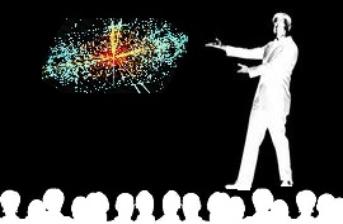
"...and this is a Higgs particle, folks! As
you can see, we took the pic just when it
collided. It has a mass of 500 gigagiga
electron volts and travels almost at the
speed of light. It decays in 10 to the
minus 43 seconds. We are certain that
new technology will come out of this
and... blah, blah, blah"

physicist: "How did he do the trick?"
mathemagician: "Easy! He first
showed an empty hat. Then he
waved his magic wand. Finally,
the rabbit appeared and the
audience clapped."
physicist: "Erm... I meant... can
you explain the physical
mechanism of how he made the
rabbit appear? How did he do the
trick?"
.
| To comment on any of the pages in this website go to: Rational Scientific Method |
Bill's books