| Neanderthal on Ice |
The Iceman Evolveth
One of the unwary victims of climate change targeted by militant environmentalists is the hapless Neanderthal.
H. neanderthalensis appears on the scene some 300,000 to 500,000 years ago, some 200,000 years before
Anatomically Modern Humans (AMH). Neanderthal evolved and lived almost exclusively in Europe. Therefore,
the argument raised by crusading climate changers that it was the weather that killed off the Neanderthals
merely exposes that these blind fanatics have substituted reasoning with emotion. This theory has a lot to do
with modern day conservationist militancy and little with what happened thousands of years ago.
The first hurdle temperature proponents will encounter is that the Neanderthals were built to withstand Arctic
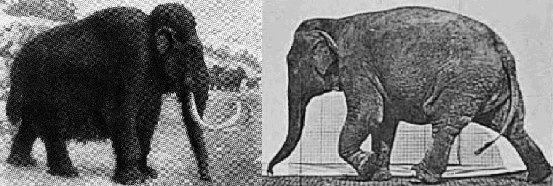
conditions. Neanderthal was the two-legged version of the polar bear and the mammoth. Do polar bears catch
the flu while floating on glaciers? Did the mammoths shiver at the sight of the first snows and seek shelter?
And Neanderthal not only lived in caves, but had mastered fire! If anything, he would have outlived the
mammoths who did not enjoy the benefits of this technology. Neanderthal did not discover fire because he
feared the cold. The cave and the fire were there for protection. Neanderthal feared being attacked by animals.
But if push came to shove, Neanderthals would have done what all animals do when the going gets rough.
They get going. Neanderthals would have migrated to warmer climates. They would have been the last ones
out. Yet, the Woolly Mammoths they hunted outlived them by 30,000 years!
The Neanderthals may have been brutes, but they were not as stupid as our paleo-mathemagicians!

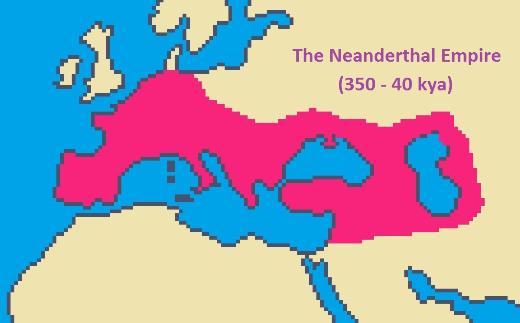
| The Neanderthal Range Neanderthal lived primarily in Europe and was well-adapted to cold weather. |
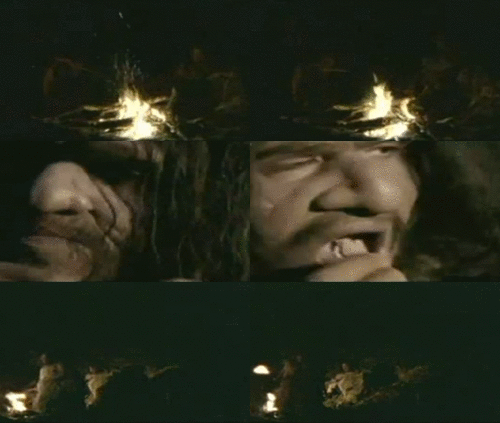
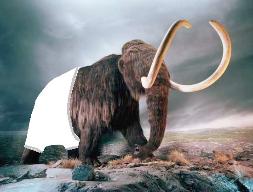

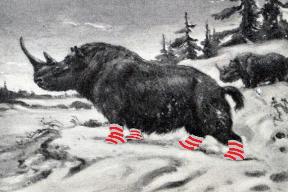
Contemporary paleontologists unjustifiably dress Neanderthals in clothes. It is much more likely that Neanderthals never discovered/invented clothes... any more than mammoths ever discovered furs. Would it make sense to illustrate Woolly in underwear? Neanderthal was almost certainly a hairy creature, much like a gorilla -- the Woolly Man, so to speak. He needed clothes as much as the Woolly Rhino he hunted in the Pleistocene. |
Chilly natives
On their trip through the Magellan Straights, Captain Fitz Roy and Charles Darwin documented that Fuegians
used little to no clothes even in winter and dove into the waters to collect fish. In contrast, Amazon natives
never had the need to invent clothes other than for ornamental purposes and costumes. They don't usually
wear clothes even to this day.
We should conclude that it was our forefathers, the AMHs who invented clothes when they ventured into
Europe about 35,000 years ago. Unlike the Neanderthals, the Cromagnons had no natural resistance to low
temperatures. They migrated from Africa where the climates were less extreme, likely following the herds.
As they encountered animals they had never seen before (Woolly Mammoths and Rhinos) and saw the
vastness of game, they continued to explore and migrate further north. The Neanderthals were in remission
by then. They had evolved from the same stem as humans, but 200,000 or so years earlier. They were an
old species, devoid of genetic diversity by the end of their days and experiencing the inevitable overturning
of their population pyramid.
Neanderthals were well adapted to the cold. Nevertheless, they lived in caves and had 'domesticated' fire. This should have given them an advantage over other animals. Yet, the Woolly Mammoths outlived them by more than 20,000 years! |
Opposite Poles Man was to Neanderthal what elephants were to mammoths: the warm climate counterpart. The 'hairy' developed in cold climates. The 'hairless' developed in warm climates. Humans were able to migrate into Europe after they invented clothes. So how is it that the cold killed off Neanderthal and spared Woolly if Neanderthal lived in caves, used fire, and was supposedly more intelligent? Why didn't he migrate south if the climate was so unforgiving? |
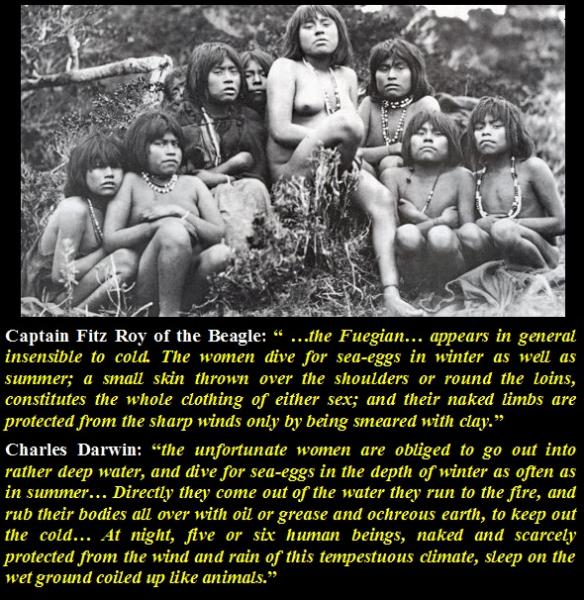
If Yaghans lived nude in Tierra del
Fuego until the Europeans came,
certainly Neanderthal, who was
much more adapted to cold climates,
was in no need of clothes either.
In fact, CroMagnon likely invented
clothes when he first drifted into
Europe in the Upper Paleolithic.
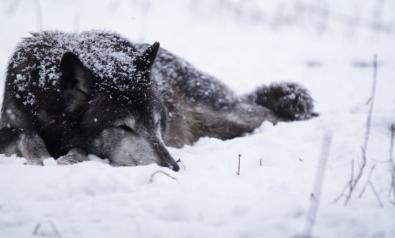
Wolves SLEEP in the snow!!! It's their natural habitat! Wolves don't wear pajamas. There are no tailors in Wolfland! |
Clothed Neanderthal? >> What will they invent next? Clothed Homo heidelbergensis? v v |



Not only are the directors sculpting the facial features of the Neanderthals and tailoring the story plots to fit in with the hybridization theory, but they have partially dressed the Neanderthals in mink coats and designer boots so they won't catch colds. Actually, the reason behind the furs and the snowshoes is that the Hollywood actors refuse to do the scene nude and barefooted in the snow. |

| Me and my old buddy Urgh I was flattered. He dressed up to receive me! Neanderthal Museum, Mettmann, Germany, 2015 |
No shirt, no shoes, no service
Monk in boots
Your guess is as good as mine, but I would venture to say that Neanderthals were almost certainly hairier than
humans. We should imagine them as 'the Woolly Man'. It is perplexing then -- and quite amusing really) -- to see
curators and documentary film makers dressing up Neanderthal in designer leather. It makes you wonder what
they wore underneath to cover their private parts. Did Neanderthal babies also wear diapers?
So when did Neanderthals invent clothes? Was it 400,000 years ago when they were starting to adapt to
the implacable European winters? Or did they inherit this warming technology from their progenitors the
Heidelbergers, the Antecessors, and/or the Homo erectus? Did these three species of monkeys develop the
technology in Arctic Europe and then bequeath it to the Neanderthals or did they import it from Africa?
Neanderthal probably had 10 inches of fat under his skin. What need did he have for clothes if he could sleep
overnight on a blanket of snow? Did the Woolly Mammoth also dress up in braziers and skirts to fight the cold?
Did the Woolly Rhino wear socks to avoid freezing to death?

This archaic fellow at the Neanderthal Museum in Mettmann, Germany, is only missing his tie. Perhaps the H. heidelbergensis on the left borrowed it... |
.
| To comment on any of the pages in this website go to: Rational Scientific Method |


| The History of Life on Earth |

| O The Paleo Establishment's main theories regarding the extinction of the Neanderthals Love War Climate Volcano Disease Trade How Woolly died |