| Whither the Woolly |
Woolly trade
The Woolly Mammoth roamed the Earth starting about 400,000 years ago, coincidentally from about the time
the Neanderthals developed in Europe. The two species probably evolved in a symbiotic relationship. The
Woollies disappeared from continental Northern Europe anywhere between 10,000 an 15,000 years ago,
depending on who you talk to. In other words, they outlasted the Neanderthals by anywhere between 20,000
and 30,000 years.
What happened to them? How come they outlived those who preyed on them throughout the Upper Paleolithic?
Paleontologists are brainwashed to repeat the same mantra over and over: over-predation and/or climate
change were the mechanisms that wiped out the hairy elephants. What else can they think of if the paleonto-
logists keep reinforcing this nonsense to each other week after week, decade after decade, college after
college, and journal after journal?
Cold feet
The proposal that the Woollies disappeared because they shivered to death is just as ridiculous as the
Neanderthal Climate Change Theory. It has all to do with contemporary militant environmentalist agendas
and nothing at all with what happened in prehistory. It is the global-warming-and-health, chicken-little crowd
-- environmentalists, conservationists, animal lovers, vegans, vegetarians and the like -- lobbysists that
crusade against Monsanto-types, as well as against polluting corporations and countries, that fanatically
believe that the weather kills species. These folk want to live to the age of 200 and leave a pristine garden
for the future generations. They don't want to die of cancer and other illnesses which they blame on pollution
and pesticides. Therefore, when dealing with the Woollies, the health-and-conservation crowd has no trouble
extrapolating that something changed in the environment that ended up killing these archaic animals.
So let's try to visualize how it may have happened since no one in the environmental crowd will ever imagine
it for you. You certainly will never read an article in a respectable, peer-reviewed journal with a step by step
explanation.
There are a million Woollies on Earth at a given point in time. A swift Glacial Age suddenly descends upon
them. Do these low Arctic temperatures kill the million individuals? Do they freeze to death? Is this what
kills them all? Or does the snow and ice cover the greens they feed upon and starve all of them to death?
Have we found a layer of rock with a million Woolly skeletons spread across it? Or is it better to suppose
that the species died gradually over thousands of years?
Well, fortunately, the Neanderthals -- their main predators -- died out around 40,000 years ago. This means
that the Woolly population was now able to expand again.
You may argue that humans replaced Neanderthals and continued hunting the Woollies, but the argument
here is that the weather killed them off. Therefore, overkill is off limits in the instant discussion.
It is said that when the going gets rough, the rough get going. The Woollies would have done what any
animal does and would do when the environmental conditions are no longer pleasant. They migrate!
Certainly, a stampede is a much faster mechanism than a drop in temperature... unless, of course, it kills
the entire herd... which takes us back to the introduction of the climate change argument.
Let's memorize the 'law' so that the subject is never brought up again and those that propose such nonsense
are ridiculed to extinction...
- "Never in the history of life on Earth has the weather killed a single species!"
- The simple fact that any species thrives and expands for thousands of years until it finally succumbs shows
that its extinction has nothing to do with environmental change. It has solely to do with intrinsic processes of
the species. Otherwise, a species could just as well die a few years after Mother Nature spawns it if the
climate or other environmental factor changed. This has never happened, but the environmentalist is free to
produce an example.
Overkill
Perhaps evil or reckless humans wiped out the Woolly herds after the Neanderthals left. Maybe our
ancestors overindulged on Woolly meat.
So, why didn't the Neanderthals wipe out the Woollies if that's about all they ate?
You could argue that there weren't that many Neanderthals at any point in time.
Let's concede this defense for the sake of argument. How many millions of human hunter-gatherers were
there in the Upper Paleolithic? How many of these hundreds of thousands of ruthless killers do you believe
seeped into Europe?
Before you reply, keep in mind that we find fewer skeletons and skulls from anatomically modern humans
than from Neanderthals before 30,000 years ago. There is no evidence whatsoever that anatomically modern
humans outnumbered Neanderthals 10 to 1 in Europe 35,00 to 45,000 years ago. You would think that the
layer of sedimentary rock would be littered with human bodies if that were so.
More likely, the density of hunter-gatherers that drifted into Europe all the way and up to the Neolithic was
much lower than the tribes of Sioux that populated north central USA in the 19th Century. A tribe is a much
more advanced form of social and military organization than a clan. Some tribes lived almost exclusively off
of hunting and some specialized in buffalo. These animals constituted almost 100% of their meat intake.
The Sioux were never even close to annihilating their source of food. There were millions of buffalo before
white hunters began to hunt them down for economic reasons. Archaic Neanderthals and humans living in
Europe not only were much fewer population-wise, but depended on deer, bison, aurochs, fish, birds, and
other prey. There is absolutely no way that prehistoric hunter-gatherers of the Upper Paleolithic could have
wiped out the Woollies even if they tried.
When we factor that many herds of mammoths thrived and multiplied in regions uninhabited by Man, the
entire overkill theory flies out the door. The Woolly Mammoth, as well as his cousin the Mastodon, died all
alone without the help of anybody.
So, how did Woolly die?
Woolly was not the last of the elephants. We still have at least two streamlined species around today. This
already suggests to the trained rationalist that Woolly likely did not die in a mass extinction event: starvation /
food. Woolly disappeared like Neanderthal disappeared. Woolly most likely disappeared all by himself without
anybody's help in a background extinction. After 400,000 years of experiencing population bottlenecks, more
and more members of the population became older and this rugged species lost its genetic diversity. Their
global population pyramid eventually overturned and the Woollies dwindled into extinction. There's no more
mystery than that.
Now, were there predators such as lions, bears, Neanderthals, and humans that cut their numbers down?
Of course there were! Every species of prey has a predator, including viruses, bacteria, worms, and other
invisible parasites that attack from within. But the mechanism of a background extinction has nothing to do
with whittling down the population STEADILY and CONSISTENTLY until the species is no more. This is the
invisible mechanism that we must discover. We won't find the answer either in climate or in our ancestors.
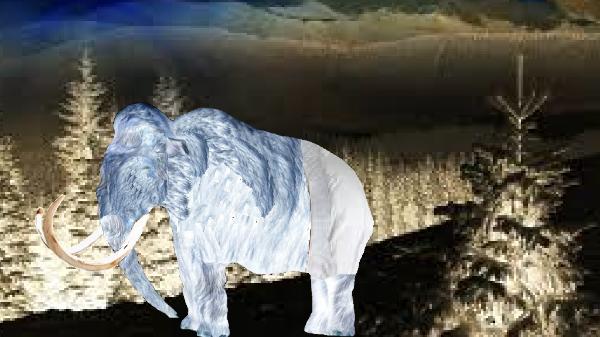
And when the Ice Age came, Shivering Woolly covered his shame. |
.
| To comment on any of the pages in this website go to: Rational Scientific Method |


| The History of Life on Earth |

| O The Paleo Establishment's main theories regarding the extinction of the Neanderthals Love War Climate Volcano Disease Trade How Woolly died |