| If objects flatten out only in the direction of travel, what happens in other directions? |
‘Real’ length contraction also contradicts relativistic assertions that the traveling object experiences no structural change.
- “ An observer moving with the velocity, v, of the stick will discover, however, that in
his frame of reference, the stick, at rest, still has the length Lo.” [1]
“ you will never notice the change regardless of how fast you are going, because
your tape measure would also be shortened from the motion.” [2]
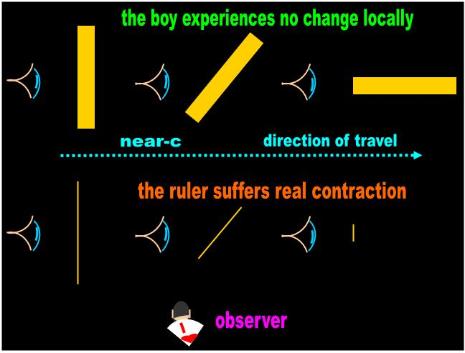
Assuming that rulers in the vicinity of the traveler shrink in the direction of motion, the boy should still be able to notice local
distortions in other directions. It would seem that if the ruler measures 12 inches long by 1 inch wide at the start of the trip, at
near-c the length of the ruler should be smaller than its width. If he spontaneously turns it 90°, now the length has to dwarf the
width (Fig. 1). Certainly, the relativistic equation predicts that a stationary observer would notice these different dimensions
from afar. If the boy doesn’t notice such vivid astigmatic distortions, especially after flattening out himself, first in one direction
and then in another as he swivels in the commander’s chair, his mother should take him to an ophthalmologist upon his return
– that is, if his eyeballs have not flattened out of existence.
| Adapted for the Internet from: Why God Doesn't Exist |
Fig. 1 Swiveling about |
The boy astronaut swivels in his chair. Relativists assert that he will not notice any physical
changes locally. However, if length contraction is real, the ruler should flatten out only in the
direction of travel, first in one direction and then in another as it rotates. Why wouldn’t the
boy notice such vivid physical changes if they are real? The fact the he and everything
around him contracts in a given direction has no bearing on the matter. Half the problem is
that the observer sees the entire picture from a lateral perspective. The boy sees everything
head on. They can never see the same thing.
changes locally. However, if length contraction is real, the ruler should flatten out only in the
direction of travel, first in one direction and then in another as it rotates. Why wouldn’t the
boy notice such vivid physical changes if they are real? The fact the he and everything
around him contracts in a given direction has no bearing on the matter. Half the problem is
that the observer sees the entire picture from a lateral perspective. The boy sees everything
head on. They can never see the same thing.
Now you know why Einstein opted to conclude that we cannot travel at c. By doing so he eluded the crucial question of
whether length contraction is real. If the effect is real, the boy will vanish entirely, and then we can’t bring him back. He has
lost length, width, and height. Einstein had no physical justification for this supernatural conclusion. So he thought it safer
to say that we can’t travel at c, that only distant observers notice length contractions, and that when the parties meet again,
the boy and the ruler regain their normal sizes. The fact that the boy and the ruler travel at the same speed and inhabit the
same inertial frame of reference is irrelevant in this context and doesn’t change real contraction. If the ruler physically
flattens out only in the direction of travel, the boy should notice this as much as any distant observer. This means that if the
Milky Way is traveling at the speed of light from another one, Special Relativity 'predicts' that you should see all the rulers in
your vicinity shrink in the direction of travel. Of course, the length contraction claim of relativity is nonsense just like
everything else coming out of Mathematical Physics!

| You should not notice any difference, Bill! Our speed only affects the observers' eyes! |

| I don't think I can keep up with the young generation! |


| What happens when we turn the corner, Steve? Will we regain our weights and sizes? |
Pages in this module:
a. QM’s ‘mother of all particles’ prevents SR’s ruler from disappearing if it travels at c
b. This page: If objects flatten out only in the direction of travel, what happens in other directions?
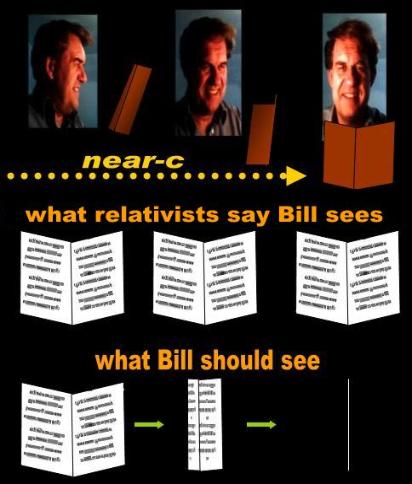
| Swiveling Bill .his stomach turning with every ad hoc physical interpretation of relativity |
| Bill is reading a book while swiveling in his chair. He is in a rocket traveling at near-c. SR claims that an extrinsic observer should measure that Bill and his book contract in the direction of travel. But then Bill should also see his book contract when he swivels perpendicular to his direction of travel. The fact that both Bill and his book are in the same frame of reference has nothing to do with the justification relativists provide for why either contracts. The book should contract only in the direction of travel. Both Bill and an extrinsic should see the same thing. Bill is an observer with respect to his book, frame or no frame of reference! What's the frame of reference got to do with the instant explanation if the justification for contraction is the speed of light in a given direction? |

- ________________________________________________________________________________________
- Copyright © by Nila Gaede 2008