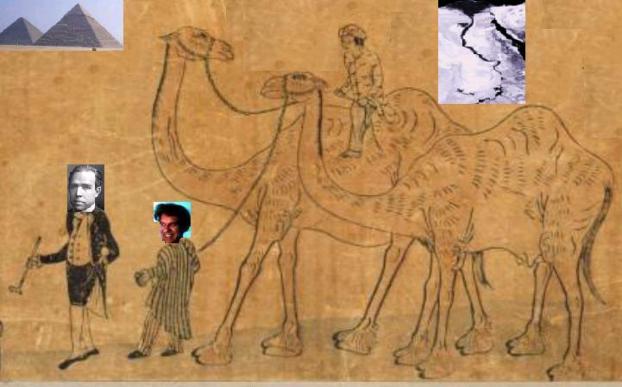
"You know Bill, the Nile is frozen stiff! That’s not a theory. That’s a fact. [1] And I ran into a couple of non-specialists last night
at the hotel and I couldn’t convince them of it. It is quite troubling that people have such terrible misconceptions about
contemporary science. It makes me wonder whether we, the scientists, are ever going to communicate our theories to mortals
effectively.”
“The Nile is frozen stiff?”
He stared at me in disbelief. “Don’t tell me that you are in the same boat with them.”
“Well, Niels, as you know I am not an expert in these matters nor do I claim to be. I just… you know, here we are in front of the
Nile River and it is… it would seem to be flowing. If you ask anybody, they would probably tell you the same thing: that it looks
quite like… well, like a liquid. Isn’t that why we call it the Nile River?”
Niels exploded in laughter. “Ah, ma boy. Intuition! You make the same mistake that these fellows made last night. You are
substituting common sense for scientific rigor. [2] You forget that common sense is the least common of all senses. What is
fluid to one is rigid to another. Opinions are no substitute for authentic science. We have to settle these matters with objective
criteria, with Mathematics. [3] The scientists at SLAC and Caltech ran a joint project funded by NASA a couple of years ago.
The results were out a couple of months ago. The team proved conclusively that the Nile is a strip of ice. Not a single drop of
water moves in it! All the fish are suspended in time. Talk about counter-intuitive! Ha! Crazy world, eh Bill!”
“But look, Niels. Look at that croc. It’s paddling towards the opposite shore.”
“Nonsense, ma boy! An optical illusion! Nothing but a mirage! You’ve probably been out in the sun too long today.”
“Hmmm. I could have sworn I saw a leaf riding the current a minute ago.”
“Yeah, it can be tricky. I’ve seen such phenomena fool even the most cautious mathematician! But equations don’t lie. [4]
And neither do the mathematicians. Believe me, it’s settled. The Nile is frozen stiff.”
“Even where it crosses the equator?”
“Yep!”
“Well, I guess that if the experts of the establishment have settled that the Nile is a strip of ice, then there is nothing more to
argue. What can lesser mortals contribute to science?”
“Right! But that’s not the end of it. After we talked with these laymen about the Nile, I couldn’t convince them about the
fundamentals of space either. That was even more frustrating.”
“Don’t tell me that space is also a piece of ice…”
“No, not quite, although it’s cold out there you know. Ha, ha, ha… Nah. I couldn’t convince them that space is a physical
object.” [5]
“A physical object?”
“Yeah. You have a problem with that too?”
“Well, no. It’s just that… you know… most people think of space as a void, as nothing.”
“Intuition ma boy, intuition! God! When will people come around? The man on the street relies so much on his instinct to
the detriment of hundreds of years of rational mathematics propping up our conclusions.” [6]
“I presume that you are referring to a physical thing like a chair or a rock?”
“Oh, you are too modest. Space is not only an object. It is almost a perfectly rigid object. Space is the most rigid stuff in the
Universe!”
“Rigid?”
“Yeah.”
“You mean rigid like a steel beam?”
- “Steel? Steel is paper tissue compared to space. Space is a billion billion billion times stiffer than steel!” [7]
“Huh! Who would have thought…”
“…and I couldn’t persuade these guys of this fact. I tried to convince them that Einstein’s equations predict the stiffness of
space.”
“They do?”
“Yeah. Relativity has already proven time and again that space is warped. [8] Without curved space what would the Earth
roll on around the Sun? [9] What would a photon slide on during gravitational lensing? [10] If space were what these guys
said –- nothing, can you believe it? –- how would the Sun generate its gravity well? People don’t think! They just try to be
logical. [11] The nerve of some…”
“But have gravity wells been confirmed?”
“Of course! You think I am talking out of my ass? But even if space were not perfectly rigid, the notion that it could possibly
be a void is absolutely ludicrous.”
“Why is that, Niels?”
“Because countless experiments have already shown that space is made of particles. [12] The scholars at respectable
institutions such as Fermilab and CERN routinely confirm this in the lab. Laymen call it space – God rest their souls. They
don’t know any better. We call it the Dirac Sea. [13] Of course, this is not your ordinary ocean. It is an ocean of subatomic
particles.”
“So when we travel to the Moon, we wade through a sea of particles?”
“That’s right! You see, we have already demonstrated at the accelerators that a microscopic component of space divides
into two oppositely charged particles. Given sufficient energy, we can split a particle into its two components, a particle
and its anti-particle, matter and anti-matter. [14]
“Fascinating!”
“But this is kindergarten stuff nowadays. We have also proven that the reverse is true. Two particles collide and annihilate
each other. [15] You wonder how it is possible for people like the ones I met yesterday to function in contemporary society.
They live in the Dark Ages. These gents simply don’t read the specialized journals, I guess.”
“All that high level stuff, huh?”
“Yeah. So it is not altogether surprising that they questioned the knowledge accumulated by the establishment. We don’t
even have such a thing as empty space in physics. [16] That’s an anachronism, a concept that was lost a long time ago in
history, I can’t even remember when any more.”
“You know, Niels. I enjoy talking to you because I learn in a couple minutes what it takes most people to learn in a lifetime.
I am just wondering. Why is it that astronauts can travel so freely through this medium which is made of particles and is
almost perfectly stiff? You would think that with such rigidity and so many ping-pong balls filling space, the astronauts
would have a hard time moving an inch.”
“Ah Bill! You surprise me sometimes. You raise an issue that doesn’t concern physics. That’s a question you should ask
a philosopher. [17] You see, a mathematician deals with quantitative issues. We can tell you with absolute precision how
stiff space is in comparison, say, to steel. You are asking a qualitative question. We have no way of measuring ‘why’ type
of questions. [18] In physics, it makes no sense to ask why an astronaut doesn’t bump his head against space. That’s like
you believing that the croc swam across the Nile or that the leaf was carried by the current. These are intuitive issues that
come down to opinions. We are not interested in such questions because they are unscientific. [19] There is only one
science and that’s physics. The rest is just stamp collecting.” [20]
| Niels says Nile is frozen |
The other day while walking along the Nile I had the good fortune to bump into my good friend Niels Bohr, the world famous
Danish physicist. He was in deep thought, perhaps working on one of those gedanken experiments that all those scientists
work on. To tell you the truth, I don’t understand much about their work, but it must be pretty important if they spend so much
time thinking about theories and all that. They also get these government funds and Nobel Prizes. Man, I really envy them. I
wish I was as smart as they.
- Niels was completely absorbed, lost in thought, like in another world. He looked up and the spell was gone. We did a little bit
of small talk, you know, the usual, the family, work, and all that, just to catch up on each other, but something kept troubling
Niels, perhaps the stuff he was thinking about before I interrupted him. Finally, I guess he couldn’t hold it in his head any
longer and blurted it out...
References, comments, and bibliography
- [1] " when scientists talk about the theory of evolution -- or the atomic theory or the theory of relativity,
- for that matter -- they are not expressing reservations about its truth...In addition to the theory of
evolution, meaning the idea of descent with modification, one may also speak of the fact of
evolution. The NAS defines a fact as 'an observation that has been repeatedly confirmed and for
all practical purposes is accepted as 'true.' ' The fossil record and abundant other evidence testify
that organisms have evolved through time. Although no one observed those transformations, the
indirect evidence is clear, unambiguous and compelling."
- J. Rennie, 15 Answers to Creationist Nonsense, Scientific American (July 2002).
- [Rennie and the NAS confuse 'fact' with a 'statement of the facts'.]
[2] " Modern science is difficult and often counterintuitive…Where intuition and common sense failed,
- they had to create new forms of intuition, mainly through the use of abstract mathematics… When
common sense fails, uncommon sense must be created…human cognition does not operate
according to principles of common sense.”
- L. Susskind, In defense of uncommon sense, The Edge (2005).
- " The commonsense idea that there is an objective reality 'out there all the time' is a fallacy."
P. Davies About Time, Touchstone (1995) p. 173.
[3] " Much of pseudoscience is qualitative hand-waving. Until a concept can be made quantitative, or at
- least put on a firm logical foundation, it is not science."
- V. Stenger, The Unconscious Quantum, Prometheus (1995) pp. 145 - 155.
[4] " All this is hard to grasp but mathematically it is completely rigorous."
- J. Heidmann, Cosmic Odyssey, Cambridge University Press (1989) (p. 81).
- [5] H. Genz, Nothingness: The Science of Empty Space, trans. by K. Heusch, Perseus (2001).
[6] " The universe is one immense entity composed of miniscule elements… We now want to turn our
- attention to the universe on the microscopic level, and in this world quantum physics reigns supreme…
Here once again, as with relativity, common sense is deceiving…It will take us into situations that
surpass even the craziest science fiction… However, by a mathematical process whose logic leaves
little to be desired, it is possible to calculate results with extraordinary precision. That alone justifies
the theory " (pp. 94-95, 104)
- J. Heidmann, Cosmic Odyssey, Cambridge University Press (1989) (pp. 94-95, 104)
- [7] " The most important thing to keep in mind about Einstein's Universe is the fantastic stiffness of space
- -- of the rubber sheet, if you like. Let's put it into perspective: let's say the magnitude of the stiffness
of a rubber sheet is about 1 x Using this criterion, the stiffness of solid steel is about 100 000 000 000,
or 10¹¹. Space has a magnitude of about 10 , a one with 43 zeroes after it! Space is a billion billion
billion times stiffer than steel! ... In other words, the enormous but not infinite stiffness of Einstein's
space-time tells us that, while space is not infinitely rigid, it is very, very, very rigid. In fact, odd as it
sounds, space is the most rigid stuff in the Universe."
- D. Blair, G. McNamara, Ripples on a cosmic sea, Perseus (1999) p. 20.
- " According to general relativity, space is not rigid."
- W. Kaufmann, Universe, Freeman (1991) p. 555.
- " For dissipative systems made of many particles, such as electrical conductors, the vacuum can act
as a viscous fluid."
- C. Schiller, Motion Mountain (2005) p. 881
- Space is a 'perfect fluid'.
- S. Weinberg, Cosmology and Gravitation, Wiley (1972) pp. 47 - 52.
- [So, Bill. Why is it that you say that relativists are a bunch of idiots?]
- [8] " light from the disc also loses energy – and is shifted to longer, redder wavelengths – because it has to
- work hard to escape the gravitational pull of the dense neutron star. This effect, called gravitational
redshift, is predicted by Einstein's theory of general relativity, which posits that gravity bends the fabric
of space-time.
- M. McKee, Warped space-time helps pin down neutron star size, NewScientist Space (Aug. 2007)
- [9] " Potential energy then forms a two-dimensional surface called a gravity well, with the Sun at the bottom
- and planetary orbits forming curves along it."
- S. Anderson, Introduction to Astronomy, GEM (Apr. 10, 2003).
- [10] " The gravity from a massive object (such as a galaxy cluster or black hole) can warp space-time, bending
- everything in it - including the paths followed by light rays from a bright background source"
[11] " No, no, you're not thinking; you're just being logical." Niels Bohr
- [12] " The quantum vacuum is never really empty, but instead roils with ‘virtual’ particles… As quantum Physics
- sees it, every ‘real’ particle is surrounded by a corona of virtual particles and antiparticles that bubble up
out of the vacuum, interact with one another, and then vanish, having lived on borrowed, Heisenberg
time…The quantum vacuum, then, is a seething ocean, out of which virtual particles are constantly
emerging and into which they constantly subside.”
- T. Ferris, Coming of Age in the Milky Way, Morrow (1988) p. 351-352.
- "The view of empty space -- the vacuum -- that the theory provides initially seems preposterous. It turns
out that empty space is not really empty. Rather, space is filled with small fluctuating electromagnetic
fields."
- P. Davies, Quantum Vacuum Friction, J.Opt. B: Quantum Semiclass. Opt. 7 (Mar. 1, 2005) S 40 -46.
- " In mathematics generally, particularly in topology, any form of space is considered as made up of points
as basic elements.”
- [After 2000 years, the idiots of Mathematics ended up converting space into a physical object
(i.e., shape)! It turns out that the quantum vacuum has no particles, but it is made of particles
and anti-particles. The particles and anti-particles are not sitting in empty space. Space itself
is made of these particles. That's what all these bozos went to college for. And then, of course,
just to cover all the bases, there are those who claim that there is in fact such a thing as empty
space...]
" the vacuum state (also called the vacuum) is the quantum state with the lowest possible energy. By
definition, it contains no physical particles."
- [It has energy, but no particles. Okay, I think I got it now. So what is this stuff called energy that
it has?]
[13] " The Dirac sea is a theoretical model of the vacuum as an infinite sea of particles possessing negative
- energy."
- [Yes, I think I can feel some of those negative vibes already.]
[14] " the vacuum state will not be stable: particles will be created by the disturbance caused by the changing
- gravitational field… How should we envisage the spontaneous creation of particles from the quantum
vacuum as a result of the dynamics of geometry? A helpful heuristic model was suggested long ago by
DeWitt (1979), who pointed out that the quantum vacuum is in some respects reminiscent of the aether.
It can be helpful to think of spacetime as being filled with a type of invisible fluid medium, representing
the seething background of vacuum fluctuations. Although the mechanical properties of this medium
can be peculiar, and the analogy should not be pushed too far, it is often useful to envisage the
‘quantum aether’ as possessing a form of viscosity… To illustrate the concept of vacuum viscosity,
consider the effect of an expanding universe. One can think of this either as an external disturbance
(the expansion) ‘promoting’ virtual quanta from the vacuum into real quanta…Let me now illustrate
mathematically how one may compute the density of created particles in this scenario" …blah, blah, blah
- P. Davies, Quantum Vacuum Friction, J. Opt. B: Quantum Semiclass. Opt. 7 (2005) S40 –S46.
- [So let's see if I got this straight, Paul. You start out with a fluid. Then you take the fluid and
convert it into particles. So why don't we just forget about the particles. How did the fluid
come to be? By the way, how did Merlin convert the mathematical concept 'virtual quanta'
into the physical object 'real quanta'? How do concepts such as love or justice spontaneously
acquire length, width, and height? I guess that it's this kind of high level science that convinced
the Templeton Foundation to give you that $1 mil, huh?]
[15] " Annihilation is defined as "total destruction" or "complete obliteration" of an object; having its root in the
- Latin nihil (nothing). A literal translation is "to make into nothing". In physics, the word is used to denote
the process that occurs when a subatomic particle collides with its respective antiparticle. Since energy
and momentum must be conserved, the particles are not actually made into nothing, but rather into new
particles."
- [So the guys at SLAC and CERN spend all day converting particles into particles. Man, that's
deep! I wonder how many tax dollars are channeled to this 'scientific' venture.]
[16] " Physical objects are not in space, but these objects are spatially extended (as fields). In this way the
- concept 'empty space' loses its meaning." A. Einstein
- [Yeah. And so does your stupid theory, Al!]
" In classical physics, empty space is called the vacuum. The classical vacuum is utterly featureless.
However, in quantum theory, the vacuum is a much more complex entity. The uncertainty principle allows
virtual particles (each corresponding to a quantum field) continually materialize out of the vacuum,
propagate for a short time and then vanish... i.e., no real particles are present." Quantum Field Theory
- [I wonder what is different between a real and a virtual particle. Is the shape of a virtual particle
different? Do virtual particles look like gingerbread men? What is the shape of a virtual particle
when it vanishes? By what physical mechanism does it lose length, width, and height?]
" In physics, a virtual particle is a particle-like abstraction...Virtual particles cannot be directly detected"
[I wonder why that is. Do you think that maybe it is because a virtual particle is a concept?]
"The concept of virtual particles...is rather loose and vaguely defined...virtual particles are an artifact
of perturbation theory... As such, their existence is questionable; however, the term is useful in informal,
casual conversation, or in rendering concepts into layman's terms."
[Informal? Layman? You should talk to that other guy who just explained that without virtual
particles Quantum Field Theory would disintegrate in a micro-second!]
- [17] " An interpretation of quantum mechanics is an attempt to answer the question, What exactly is the
- meaning of quantum mechanics?... Although today this question is of special interest to philosophers of
physics, many physicists continue to show a strong interest in the subject, though interest has declined
with the rise of modern theory of quantum decoherence." Interpretation of Quantum Mechanics
- [18] " Questions regarding why the universe behaves in such a way have been described by physicists and
- cosmologists as being extra-scientific." Cosmogony
" Why? Students often ask questions with the word why in them. 'Why is the sky blue?' 'Why do objects
fall to earth?' 'Why are there no bodies with negative mass?' 'Why is the universe lawful?' What sort of
answers does one desire to such a question? What sort of answers can science give? If you want some
mystical, ultimate or absolute answer, you won't get it from science. Philosophers of science point out
that science doesn't answer why questions, it only answers how questions. Science doesn't explain;
science describes."
- D. Simanek, A Glossary of Frequently Misused or Misunderstood Physics Terms and Concepts,
Lock Haven University (2004).
- [The mathematicians got it entirely in reverse. Science deals exclusively with why questions
and not at all with 'hows'. The religion of Mathematical Physics deals with how and how
much questions, and the scholars confused this nonsense for Science.A theory is an
explanation. A theory is a movie. A theory IS a WHY question! A description belongs
exclusively to the stage of the scientific method that we call hypothesis and a hypothesis
without more is not science. A description alone is not science! Anyone can describe
without understanding anything. Almost no one can explain.]
- [19] " Niels Bohr emphasized that Science is concerned with the predictions of experiments, additional questions
- are not scientific but rather meta-physical." Copenhagen Interpretation
- [Niels has it backwards. The scientific method absolutely compels him to explain 'why'
questions. Whether he ran an experiment, props his conclusions with equations, or
inferred them from a nightmare is irrelevant to Science. It is when the mathematicians
substitute Math for Physics and 'prove' their definitions that the entire circus becomes
meta-physical. Predictions are the stuff of astrologers, palm readers, charismatic preachers,
and relativists. In Science, we don't do predictions. In science, we attempt to explain what
occurred.]
- [20] " All science is either physics or stamp collecting" E. Rutherford

| You what? |
43
- ________________________________________________________________________________________
- Copyright © by Nila Gaede 2008