- a
1.0 Distance vs. distance-traveled
Hawking tells us that forces don't act upon planets to move them around the Sun. The planets are simply rolling or sliding
around warped space:
- "Bodies like the earth are not made to move on curved orbits by a force called
gravity; instead, they follow the nearest thing to a straight path in a curved space,
which is called a geodesic. A geodesic is the shortest (or longest) path between
two nearby points." (p. 29) [1]
- Thus, he introduces one of the weirdest versions of the word line known to Man. The geodesic is an unscientific concoction
of Mathematical Physics and fails as a line for several reasons:
- • it is alleged to be simultaneously a noun and a verb
• it is alleged to be both straight and curved, rectilinear and curvilinear
• the 'entity' doing the motion is a location
• it equates distance-traveled with a geometric figure
- 2.0 Is a geodesic a physical object, motion, or both?
The mathematician presents a geodesic as a geometric figure, specifically as a straight line, or insinuates that he is talking
about architecture:
- " a geodesic is a generalization of the notion of a 'straight line' to 'curved spaces'." [2]
" Geodesics are locally extremes of length... Take a strong cord and stretch it tight" [3]
" The shortest distance between two points is the length of a so-called geodesic" [4]
" The mass of the sun curves space-time in such a way that... the earth follows a
straight path in four-dimensional space-time. " (p. 30) [5]
So what are we talking about? Does the infamous geodesic refer to a highway or to an itinerary along a highway? A road is
made of dirt and perhaps asphalt. A trajectory is not made of anything except a bunch of abstract locations. A trajectory is a
movie of an object at different locations, one location per frame of the film.
So what did the mathematicians do to answer this formidable question?
The scholars found the strategic word path which ambiguously and self-servingly embodies both notions. A path can be both
a street and the itinerary along a street. A path is both a highway and hiking along the highway. In the religion of Mathematical
Physics, the word path is used simultaneously as a noun and as a verb. It is this handy duality that makes the mathematical
geodesic so formidable.
Therefore, unless we can settle whether the mathematician is referring to an object or to motion, the geodesic will remain
a formidable and enigmatic 'entity'. The first problem we will encounter is when we attempt to qualify it. Should we use
adjectives or adverbs?
- 3.0 Is a geodesic straight or rectilinear?
Scientific language is radically different than ordinary speech (i.e., religion, Mathematical Physics, astrology, etc.). In our
vernacular, the word 'motion' is a noun, and the word 'rectilinear' is an adjective, for example, the phrase 'rectilinear motion.'
Here the word motion serves as a noun, perhaps the subject of the sentence. This converts the word rectilinear into an
adjective, a qualifier of a noun.
This convention is untenable in a scientific environment. For the purposes of Science, the word motion is always treated as
a verb. Motion is what something does; not what something is. This summarily converts the word rectilinear into an adverb.
In Science, rectilinear is always and without exception an adverb, a qualifier of motion. On the other hand, for the purposes
of Science, a line is always a noun (a physical object, a geometric figure, something with shape). This notion summarily
ensures that the word straight is always an adjective. In Science, an adjective may only be used in the context of a physical
object.
The mathematicians have never learned these fundamental notions of Physics in high school or college, and this is how
they ended up introducing ordinary speech in scientific contexts. This is how contem-porary mathematicians end up
qualifying verbs with adjectives: straight trajectory, continuous motion, flat space-time, rigid vector (p. 7).
If the infamous geodesic is supposed to be a line, we can qualify it with the adjectives straight or curved. If a geodesic is
supposed to be an itinerary, we can qualify it with what for the purposes of science are adverbs: rectilinear or curvilinear.
Of course, if the geodesic is a 'path,' meaning that it is simultaneously a dirt road and a bunch of footprints, then the
mathematicians can alternatively invoke adjectives and adverbs at will when it suits their arguments:
- " space-time is not flat, as had been previously assumed: it is curved or 'warped'...
bodies like earth are not made to move on curved orbits...instead, they follow the
nearest thing to a straight path in a curved space " (p. 29) [6]
Hawking is alluding to motion but uses adjectives -- flat, curved, warped, straight -- throughout his dissertation. He could
have used the words trajectory or itinerary, but he chooses the more convenient and ambiguous path. The word path is
magical in Mathematical Physics because you never know what a mathematician is talking about. Is Hawking's term
'straight path' a highway or the footprints you left in the sand?Therefore, although it is clear that a geodesic is a movie of
a moving object, we don't find a single adverb to qualify this motion in Hawking's entire presentation.
The bad habit the mathematicians have of equating geodesics with ‘lines’ comes from the bad habit the mathematicians
have of depicting the motion of objects on a graph with a trace. They don’t realize that they are using an object (a geometric
line) to represent a movie (a series of locations of one object). By sketching a solid line, the mathematicians are stealthily
converting the movie of an itinerary into a still image. The geodesic of Mathematics is a collage, a row of frames of a film
pasted onto a photograph. The infamous 'path' of Mathematical Physics is a trace, and conveniently embodies both the
long streak marked on the paper as well as the itinerary of the pen.
- 4.0 Geodesic: a dynamic location?
- The distance of Physics is conceptually a photograph whereas the distance of Mathematics is conceptually a motion picture.
The infamous geodesic of Mathematics is therefore neither a length nor a distance, but rather a distance-traveled:
" geodesics...are infinite in the two directions: one can travel along their own
length indefinitely." [7]
" In relativistic physics, geodesics describe the motion of point particles... the
path taken by a falling rock, an orbiting satellite" [8]
One problem certainly arises when not a particle, not a dot, but a location does the traveling:
- "The crossing point, near -25 for g2p7 has moved in to near -2.4, on the slope
of hill2. A fair guess is a critical geodesic may occur when u0 is slightly lower" [9]
- [The ordered pair (x, y) moved? Oh man, that's scary!]
If the mathematicians insist so much that their points are actually locations, how is it that they visualize these abstract, static
concepts to suddenly acquire speed? How do you move a location? Nevertheless, if the mathematical geodesic is actually
a moving point, the mathematicians cannot call it a straight line. They can at best talk about an incessantly moving dot. And
certainly it doesn't belong in Geometry!
5.0 Does the word geodesic belong in Geometry?
The mathematicians tell us in their own words what a geodesic means to them:
" On a sphere we of course cannot draw a straight line between two points, but we can
draw a shortest line, really an arc of a great circle of the sphere. Such a line is termed a
geodesic, and would be marked out by a smooth thread tightly stretched along the
surface from the one point to the other. To the Filmite a geodesic will play the part of a
straight line… " [10]
" geodesic: A straight line is the shortest distance between two points, a straight line may
extend infinitely far in both directions." (p. 112) [11]
The geodesic is a fundamental concept of relativity. Without it, the crucial supernatural physical interpre-tations of this
religion (i.e., what the idiots of relativity call ‘predictions’) collapse overnight (e.g., Mercury’s perihelion shift, bending of
light/redshift, time dilation, formation of a black hole singularity, The Holy Cone of Light, etc.). So it behooves us to
determine whether the geodesic has anything to do with Geometry or Physics.
Apparently, it was Euclid who first ‘proved’ that the ‘distance’ between two points on a plane is the shortest:
- " Euclid in his work proved that the shortest distance between two points is a line; that
was the triangle inequality for his geometry." [12] …triangle inequality is the theorem
stating that for any triangle, the measure of a given side must be less than the sum of
the other two sides but greater than the difference between the two sides." [13]
[Of course, if we are going to discuss lines in terms of length, the mathematicians have no
choice but to talk about segments (i.e., finite lines). (See Bk. I, Props. 15 and 20) [14] [15] ]
Relativists extrapolated this notion 'shortest of distances' to the geodesic, an itinerary along the surface of a sphere:
- " The shortest path between two points in a curved space can be found by writing the
equation for the length of a curve, and then minimizing this length using standard
techniques of calculus and differential equations." [16]
Hawking is a maverick when it comes to the infamous geodesic. He has a slightly different version, believing that a
geodesic can also be the longest distance from one location to the other on a sphere:
- [Clearly, the longest distance we can travel between two points, whether on a sphere
or on a plane, would include an erratic itinerary that conforms neither to a straight line
nor a geodesic. The only circumstance under which the shortest and longest distances
are identical is when we refer to a static gap. Obviously, Hawking confuses ‘physical’
direct distance between two points (shortest/longest separation/gap) with distance
traveled (never the longest possible trajectory). Choose the longest distance you can
think of. I bet you I can think of a longer one. Hawking is talking about motion of one
object (Mathematics) and switches in the middle of the conversation to separation
between two static objects (Physics). ]
So let’s recap the main points to understand the problem. The mathematicians say that:
- • A geodesic is infinite in two directions (i.e., incessant walking).
• A geodesic is the shortest distance between two points (i.e., at some point you
- stop walking).
- • A geodesic is also the longest distance between two points. (You walk forever
- from one point to the other?)
A geodesic seems like a very convenient word to explain anything. It sounds like this definition is about to lead us to
another of those un-falsifiable propositions.
I conclude that the mathematicians want their cake and to eat it too. A geodesic is an itinerary along the surface of a sphere.
It does not allow the traveler to go through the sphere, for example along its diameter. So Hawking is unwittingly invoking
two distinct definitions of distance when he says that a geodesic may be both the shortest AND the longest. Relativists
have developed these poor habits because they don't define strategic words such as dimension, length, distance, and
point rigorously. Then they fail to use their lame definitions consistently throughout the dissertation anyways.
For instance, relativists hold that a sphere is a hollow shell or balloon, you know... like their skulls. If so,there is no
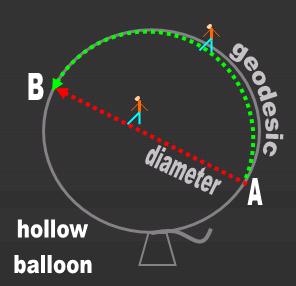
impediment to short-circuit the geodesic with a straight line running directly through the interior of the sphere (Fig. 1).
Let me run that by again. The mathematician begins his presentation by telling you that a geodesic is the shortest distance
between two locations on a sphere. He draws a curve along its surface and calls it a straight line. You tell the numskull that
he can draw a shorter line if he cuts through the sphere. The idiot replies that you cannot travel through the Earth. You must
go from Buenos Aires to Tokyo around it. This, he tells you, is the shortest path. However, the sphere of Mathematics is
defined as a hollow shell 'made' of 0-D points (i.e., locations).
" the term 'sphere' refers to the surface only, so the usual sphere is a two-dimensional
surface. The colloquial practice of using the term "sphere" to refer to the interior of a
sphere is therefore discouraged, with the interior of the sphere (i.e., the 'solid sphere')
being more properly termed a 'ball.' " [18]
Pursuant to their own definition, what impediment is there to travel through the interior of a balloon as opposed to around
its surface? To win the debate, the morons of Mathematics borrow the geodesic of Math and the solid sphere of Physics.
The mathematicians treat the sphere as a bowling ball when it suits their arguments. Nevertheless, if I dig a tunnel through
the Earth to go from Mexico to the US, will the morons of Mathematics insist that the curve they call a geodesic running
through Immigration is the shortest path? The mathematicians of the world are a bunch of idiots! That's what they are! We
have too much respect for them. They throw this type of logic at you in their chats and forums and want you to think that
you are the one who has to visit the psychologist.
If the geodesic of Mathematics is a verb, it does not belong in Geometry. The definition of architecture cannot be predicated
on motion. We are not looking at a still image of a static geometric figure we call a line. We are watching a video of a trajectory.
The tracing of such line necessarily involves two or more locations of the pen, and viewing the construction of this line
necessarily invokes two or more frames of the film. Without the film or memory, we cannot conceive of the mathematical
geodesic.
Because it is defined as a series of discrete locations, motion is a segmented concept. Therefore, if a geodesic is an itinerary,
it also conceptually segmented, and if it is segmented, it cannot be straight. It can at best be rectilinear. Indeed, in Science, it
is irrational to use adjectives such as straight to qualify motion.
Fig. 1 Hollow numbskulls |

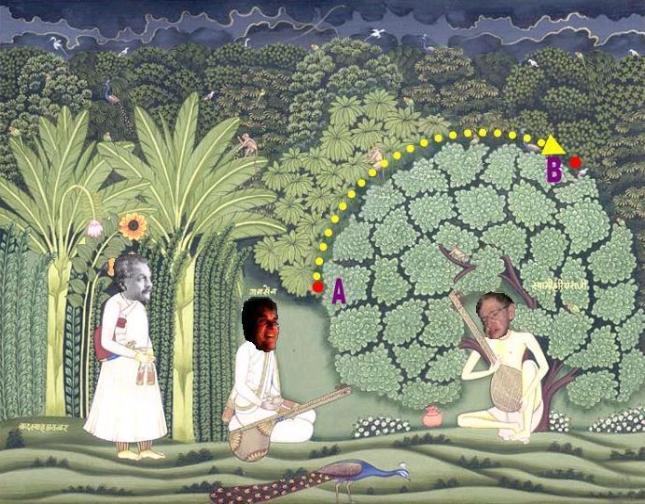
| Look at the red ball, Novice Bill. You see how it goes back and forth when I shake the tree? That's what we call a geodesic in relativity! That's a straight line! |
| You and your friend depart from the same location (A) on a balloon and walk towards B. You walk through the hollow shell along the diameter (red itinerary) and he goes around the circumference (green itinerary). Who has the shortest route? Relativists allege that the green path is the shortest route. The reason they reach this conclusion is that they insinuate that you can’t go through the sphere because it is a solid ball. (Perhaps they have planet Earth in mind?) However, the official definition of the word sphere in Mathematics is the notion of a hollow balloon. The only reason the mathematicians can get away with their ridiculous explanation is that they arbitrarily invoke the geodesic of Math and the sphere of Physics when it suits their arguments. If tomorrow we perforate through the core of the planet, will the idiots of Mathematics continue to insist that a geodesic (along the surface of Earth) is the shortest length or distance between Tokyo and Buenos Aires? |
- Module main page: A line is NOT the shortest distance between two points
Pages in this module:
- 1. The primitive line
2. Endless breath: Euclid's breadthless length
3. The hinge
4. Hilbert's two bit line
5. Is a line continuous or segmented?
6. Weyl's shortest distance
7. This page: Hawking's geodesic
8. Anderson's footprints
9. Weyl's idiotic all-in-one line
10. The equation line
11. So then, what is a line?
| Adapted for the Internet from: Why God Doesn't Exist |
| Hawking's geodesic |

- ________________________________________________________________________________________
- Copyright © by Nila Gaede 2008