1.0 In Physics, there are no observers
Measurement is an activity circumscribed to Mathematics. In Physics, we don't take measurements, in great measure,
because this would convert Physics into a subjective discipline such as Mathematics. You measured 5.111 cm. I
measured 5.112 cm. Who's right? Should we argue before a jury and submit it to a vote?
In Physics, if we have an arbitrary standard, say a ruler that measures 1 meter, the length of the croc is so many multiples
of that specific ruler irrespective of measurement or knowledge. The length and distance of Physics have nothing to do
with the activity of measuring. In Physics, length and distance are strictly qualitative parameters or attributes. A table has
length even before we call a mathematician to take a petty measurement. And a table has so many units and partial units
of the measuring tape you hold in your hand before you take a measurement. The measurement you take with the tape is
nothing but an approximation to that exact magnitude.
An example of the qualitative, real distance of Physics is the gap between the edges of a cave entrance. If the bear is too
fat, she will not make it through the opening. We do not verify this by taking a measurement of the bear and comparing it
against the distance between the rocks like they would in Mathematics. We certify this when the bear can’t get out of the
cave (Fig. 1). This is not a question of scales or of centimeters. This is a black or white, yes or no, qualitative type of issue.
Either the bear makes it out or she doesn’t. Another example is a stick that you use to pull your cap from the river. You
don't need to measure from the floating cap to the bank of the river and then search for a branch that fits the specification
that the calculator spit out. You instinctively grab a stick near you and either it is long enough to do retrieve the cap or it
isn't. And you don’t need equations to realize that a balloon is smaller after it lost air. All you need is your eyes (or your
imagination). Actually, this is a conceptual issue that follows from the definitions of 'smaller' and 'lost air'. You don't need
to go to college and learn high level Math to understand the distance we use in Science.
| In Physics, we don't measure distance |
| Adapted for the Internet from: Why God Doesn't Exist |
2.0 A scientific definition is one that can be used consistently
The mathematician may complain that he has no use for the definitions that I am proposing. They are not practical, so
what's the point of formulating such definitions if they do not serve a purpose?
The fact that these definitions cannot be used in Mathematics only underscores how different Math is from Physics.
Unlike the definitions of Mathematics, these definitions can be used to explain a scientific theory. A scientific definition
is one that you can use consistently in a dissertation or discussion. Otherwise, you have a mathematical definition (also
known as an irrational or operational definition). The definitions of Physics have the advantage that they can provide a
rational physical interpretation to a phenomenon of nature. We cannot do this with the incongruous blend used by the
mathematicians. Just when you thought that the dimwitted spokesman from NASA was talking about length, he was
actually referring to distance, and it really wasn't a distance, but more like a displacement. You know. The speaker wasn't
actually referring to the separation between TWO objects. He was talking about how many seconds it took ONE object to
get from here to there. He wraps up his presentation by asking you to accept this 'itinerary' as a length. So what was he
talking about? Length, distance, displacement, or time? Architecture or motion? Objects or concepts? It is this
inconsistency in the use of definitions that converts Mathematical Physics into a religion.
3.0 Conclusions
Measurement is an activity invented by a peculiar species of the animal kingdom known as mathematicians. These
creatures create a standard, for example the meter, and then place it next to objects or between them to quantify what
they call length or distance. Yet this is clearly unrelated to Science. The Universe was doing its thing before any
mathematician came along. There is a distance between the Moon and the Earth whether there is anyone there to
measure or not, and Venus has a certain circumference and a certain diameter whether life develops on Earth or not.
Hopefully, things have length even before a mathematician pulls out his rod and calculator or creates a standard. This
is the length of Physics. The religion of Mathematical Physics relies exclusively on testimonials. Physics does not.
Fig. 1 Distance |

| Mauled Bill |
| An example of qualitative distance is the entrance to a cave. We don't certify this by measuring from one edge of the opening to another. We certify this when the bear can't get out (...or when Bill loses his arms!) |
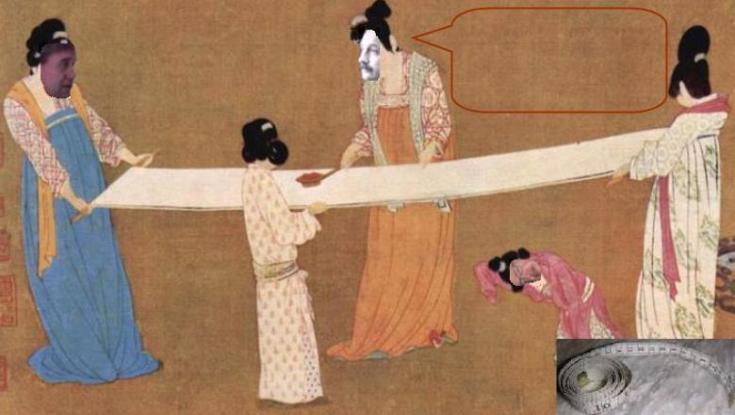
| Until we find that damned measuring tape, this cloth doesn't have length! |
Module main page: A mathematician doesn't understand the difference between length and distance
Pages in this module:
- 1. Length and distance are not synonyms for the purposes of Science
2. This page: In Physics, we don't measure distance
3. In Mathematics, there is no such concept as distance
4. In Science, it is irrational to attempt to measure distance
5. Is the radius of a circle a distance or a length?

- ________________________________________________________________________________________
- Copyright © by Nila Gaede 2008