1.0 A radius is not a distance
Many of the supernatural physical interpretations of Mathematical Physics are due to the misconceived notion of the word
distance. Perhaps the most ridiculous example is Special Relativity’s length / distance contraction of the muon. Here I look
at a lesser one.
Radius is the property of ONE physical object whereas distance is the separation between TWO of them. Radius is either a
length or a measure of length. It should never be confused for a distance. The Earth has a radius: the qualitative or
quantitative length from the center of the Earth to its surface. The orbit of the Moon does not have a radius. Now we are
talking about the distance or qualitative separation from the center of the Earth to the center of the Moon (or to a
hypothetical location known as their respective centers of mass). If we quantify this distance, we are not talking about either
length or distance. We are now alluding to distance-traveled, the number of tiles we placed as we walked from the center of
the Earth to the center of the Moon. Mathematical units such as the meter or the mile are NOT measures of length or distance.
They are measures of distance-traveled. There is no such thing as a static concept in the whole of Mathematics! A
mathematician would have no use for it.
If we say 'the radius of a circle,' we are alluding to a qualitative parameter, an imaginary length extending from the center to
the edge of the circle. If we instead say that 'the radius of the circle is 15 meters,' we are now alluding to a quantitative
parameter. We are talking about a number line. We walk along the number line to the number 15 and place a unit such as
meter after the number. Neither of these concepts should be confused with a dimension. In any of its forms, a radius is not
the same as the length of 'length, width, and height' fame. Radius has nothing to do with the object being 2-D or 3-D.
2.0 The gravity of the situation
The idiots of Mathematics have for centuries confused radius with distance. For instance, the mathematicians routinely
calculate gravity between two spherical celestial objects using distance, but call it radius, and use the little r symbol. The
reason for this has to do with the fact that the mathematicians define a circle as an orbiting object. The circle of Mathematics
is not a geometric figure. It is a movie of something flying around a path that looks like a circumference (for no reason
justifiable in Physics ). In Physics, a movie does not qualify as a geometric figure.
Newton’s gravitation equation is oftentimes written F= GM / r². This equation represents the gravity that an object such as
the Earth would experience as a result of the influence of the Sun. Here, the big M represents the mass of the Sun and the r
is supposed to represent the radius of an imaginary circle that has the center of mass of the Sun as its center and the center
of mass of the Earth as its endpoint.
The problem with this equation is that it could be misleading if people are blind sided to the fact that we are talking about
the abstract concept 'center of mass' and not about objects. This equation makes no provision for shape.
For example, the Earth has a flattened-out shape in reality. It is flattened at the poles and elongated at the equator. The Earth
is not an ideal sphere. It looks more like an oblate spheroid. Even in the best case scenario, if we were to take the 'radius' of
the Moon's orbit, assume that it is perfectly circular, and that this orbit has its center located in the 'center of mass' of a static
Earth, we can’t use the equation (F = G M / r²) to calculate the gravity the Earth exerts on the Moon. The shape of the Earth is
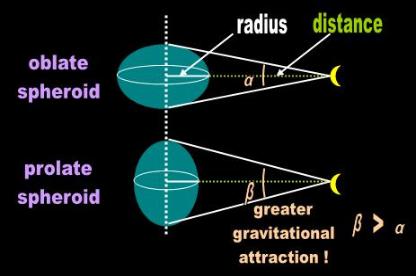
now essential. For instance, in Fig. 1, I compare an oblate spheroid and a prolate spheroid. These two configurations do not
generate the same gravitational strength. The prolate spheroid would exert a greater attraction on the Moon. This is due to
distance only indirectly. The physical reason has to do with the number of EM ropes converging on the object (in this case
the Moon). More ropes superimpose in the oblate scenario and the angles at which the ropes come from the Earth's poles
to the Moon favors the prolate configuration.
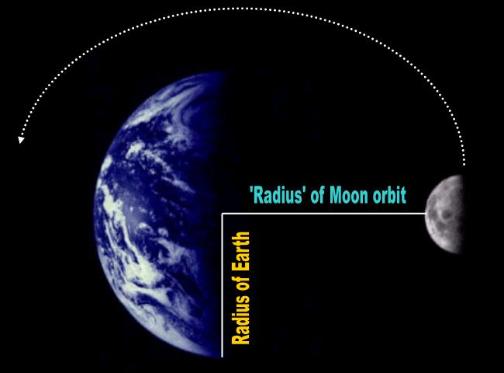
Is the radius of a circle a distance or a length? |
Adapted for the Internet from: Why God Doesn't Exist |

| It is well-established in relativity that the radius of the Earth is shorter than the radius of the Moon's orbit. |


Module main page: A mathematician doesn't understand the difference between length and distance
Pages in this module:
- 1. Length and distance are not synonyms for the purposes of Science
2. In Physics, we don't measure distance
3. In Mathematics, there is no such concept as distance
4. In Science, it is irrational to attempt to measure distance
5. This page: Is the radius of a circle a distance or a length?
Fig. 1 |
An oblate spheroid generates less
gravitational attraction than the
same amount of matter recon-
figured into a prolate spheroid.
This difference has nothing to
do with the radius of the spheroid
or the distance traveled from the
center of the spheroid to the Moon.
It has to do with distance, but only
indirectly. The invisible mechanism
producing gravity consists of
countless ropes that interconnect
every atom in each object. The
prolate spheroid configuration has
a wider angle converging upon the
Moon
gravitational attraction than the
same amount of matter recon-
figured into a prolate spheroid.
This difference has nothing to
do with the radius of the spheroid
or the distance traveled from the
center of the spheroid to the Moon.
It has to do with distance, but only
indirectly. The invisible mechanism
producing gravity consists of
countless ropes that interconnect
every atom in each object. The
prolate spheroid configuration has
a wider angle converging upon the
Moon
The more correct gravitation equation to use is (F = G M m / d²). The other one is just a ball-park figure: it is a shorthand.
The gravitational equation contains two masses (M and m), where d represents the distance between them. Here, we are
not referring to distance-traveled, but to static distance: the separation between two surfaces. The reason distance is
involved and not distance-traveled is that the ropes work by aggregation. The shorthand version (F= G M / r²) has a single
mass (M) and confuses radius with distance-traveled. Neither of these equations makes allowances for the shape of the
objects. Radius has to do with physical objects (i.e., geometric figures), for example, the radius of a circle or a sphere.
Distance has to do with emptiness between two objects, for example, between the ears of a mathematician.

- ________________________________________________________________________________________
- Copyright © by Nila Gaede 2008