| Adapted for the Internet from: Why God Doesn't Exist |
- The attempt to illustrate space-time through analogies after declaring it to be unapproachable other than through equations
makes me question whether relativists understand their own theory. In 300 years of Gravitation, not once does Linde warn lay
readers that his 3-D ant hole is supposed to be taken figuratively. (p. 625) [1] Nor does Turok clarify to the lay subscribers of
the popular magazine Astronomy that his 3-D pea should be regarded solely as an analogy. [Yulsman, Give Peas a Chance,
Astronomy 9 (1999)] [2] Could it be that the experts are foolish enough to draw their 3-D contraptions on their private
blackboards like they describe them to you in their articles? Do the mathematicians confuse analogies for the real thing?
( Click here to find out.)
More fundamentally, the attempt to illustrate space-time underscores the mathematicians’ true intentions. An analogy is a
form of logical inference used to invoke similarity of relations between things. An analogy has to do with conduct and not
with structure. A typical analogy goes something like this: ‘John works like a horse.’ We are not comparing John and the
horse physically. We are NOT saying that John looks like a horse. We are saying that John acts like a horse.
Mathematical physicists self-servingly misuse or over-stretch the sense of the word analogy. They say things like, ‘a
hypersphere is to a sphere what a sphere is to a circle’ and call it an analogy, when it is clear that we are alluding to
architecture and not to behavior. One of a group of things that are structurally similar is known as an example. When
we ascribe physical attributes of one object to another we call it a simile. And we use the word mockup to refer to
specific types of examples, for instance, a scaled model of an actual object. Therefore, a sphere, an ant hole, and a
pea can at best serve as examples, similes, or mockups of space-time, but hardly as analogies. Relativists may argue
that they need to invoke examples and mockups to illustrate or describe the object Universe (i.e., its large-scale
structure). They may not argue that they need an analogy to 'explain' a physical object or that you need to visualize it in
a series of steps. The mathematician doesn't point to space-time. He spends his time telling you how space-time behaves
or how the mathematicians inferred space-time from equations. The task before us has to do with static shape and not
with dynamic relations or with how a mathematician came across his knowledge. We are interested in illustrating the
object relativists call space-time or, in the alternative, in understanding why relativists cannot visualize their fundamental
hypothesis. There should be no need to watch a movie. We should be staring at a still image.
My argument may strike the reader as trivial and strictly semantic. However, a quick analysis shows that it runs much
deeper. One reason that relativists resort to analogies becomes apparent from the insurmountable difficulties they
encounter when attempting to illustrate space-time. A simile, an example, or a mockup would be structurally comparable
to the real thing and would compel them to illustrate what they have in their minds. For example, if I want to show you
what a grain of sugar looks like, I could point to the baby’s block. This does not mean that the block is a grain of sugar.
The block is an example or a mockup of a grain of sugar. Now that you visualized the object at the center of my
dissertation, you have a chance to understand, my explanation, for example, my theory of how the cube dissolves in
coffee. The cube serves as Exhibit A in my presentation. Without it, I cannot explain and you will not understand how a
sugar cube dissolves if you have no prior experience with blocks or sugar cubes. Relativists routinely bypass the
exhibits phase of the scientific method. They explain their sugar-and-coffee theories without the sugar or the coffee.
The alleged ‘analogies’ of space-time are smoke-screens for an inexistent object. Wittgenstein cautioned against those
who fall back on such tactics:
- “a simile must be a simile for something. And if I can describe a fact by means of
a simile I must also be able to drop the simile and to describe the facts without it.
Now in our case as soon as we try to drop the simile and simply to state the facts
behind it, we find that there are no such facts. And so, what at first seemed to be
a simile now seems to be mere nonsense.” [3]
When you peel the onion to the core in relativity, you find nothing at its center. The famous yellow brick road of GR
conduces to nowhere.
The real reason relativists resort to analogies (as opposed to examples, similes, and mockups) is to get their mathematical
foot in the door. We need Mathematics if we wish to compare the weight of an apple against that of an orange or to predict
the speed of a worm within the apple. We don’t need Mathematics to visualize an apple. Mathematics is exclusively a
dynamic discipline. By relying on analogies relativists are subtly opening a door that enables them to invoke equations
and numbers in situations that don’t require them. Whether space or space-time are physical objects or whether space is
curved or straight are qualitative, structural issues; numbers have no relevance in such contexts. Therefore, it is ludicrous
for the mathematicians to ask you to take a college Math course to ‘understand’ the shape of space-time. The only thing
you need to visualize a physical object – if this is what space-time is supposed to be – is your eyes! Concepts and theories
we understand. Objects we see. If we can’t visualize space-time, it is perhaps because there is no such object. Perhaps, like
the emperor's tailors, the mathematicians are asking you to believe in an inexistent robe.
A more interesting twist to this argument is that the most famous example of relativity is not an 'analogy'. It turns out that the
sphere that relativists point to is the real McCoy.
| Why must relativists resort to analogies? |
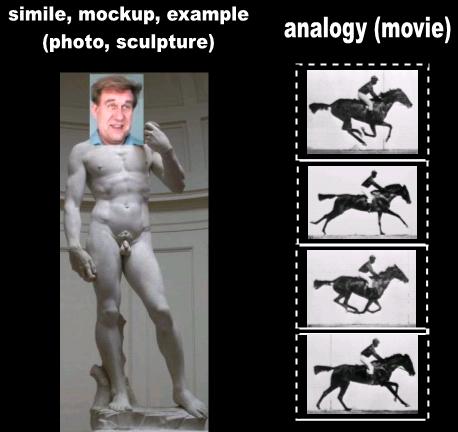
| "Bill looks like a statue." |
| "Bill gallops like a horse." |
Module main page: General Relativity: A contemporary Emperor's Clothes tale
Pages in this module:
- 1. Why can't relativists even imagine space-time?
2. Is space-time 2-D, 3-D, or 4-D?
3. This page: Why must relativists resort to analogies?
4. A sphere is not an analogy, but the real McCoy
5. In relativity, a solid may be 2-D
6. In what way does time affect the shape of a cube?
7. Is the Universe closed, open, or flat?
8. Analogies are for laymen?
9. Analogies cannot help you see space-time

- ________________________________________________________________________________________
- Copyright © by Nila Gaede 2008