| Adapted for the Internet from: Why God Doesn't Exist |
1.0 The definition of property
The differences between bundle and substance ‘theories’ of objecthood are ultimately traceable to two incompatible
perceptions of the word property: ‘something owned’ versus ‘an attribute possessed by all members of a category.’
The bundle theorists think of a property as ‘something owned’ and predictably focus on words that describe features
or highlight behaviors of an object or relations between objects. These philosophers think of an object in terms of:
- “ A property is that which not at all Can be disjoined and severed from a thing Without
a fatal dissolution… touch to corporal things, Intangibility to the viewless void.” [1]
The bundle ontologist focuses on:
- • what it looks like:
- “ table: An article of furniture supported by one or more vertical legs and having a flat
horizontal surface.” [2]
- • what its purpose is:
- “ An anvil is a manufacturing tool, made of a hard and massive block of stone or metal
used as a support for chiseling and hammering other objects.” [3]
- • how it is built:
- “ In physics, a physical body (sometimes called simply a body or even an object) is a
collection of masses, taken to be one. For example, a baseball can be considered
an object but the baseball also consists of many particles (pieces of matter).” [4]
- • whether it is real or ideal:
- “ For Plato, these Forms are perfect Ideals, but they are also more real than physical
objects.” [5]
- • what it does:
- “ A tape recorder… records and plays back sound.” [6]
The substance ontologists, on the other hand, think of a property as ‘that which is common to all.’
- “ Categorization is the process in which ideas and objects are recognised,
differentiated and understood. Categorization implies that objects are grouped
into categories” [7]
- “ In mathematics, category theory deals in an abstract way with mathematical
structures and relationships between them.” [8]
The substance philosophers have converted the word object into a category. What they failed to do is identify what
it is that is common to all objects. What is this mysterious ‘property’ called substance?
Most of the difficulty in deciding what properties to include and which to reject can in turn be traced to the misconceived
notion that a property of an object is that which an observer can detect. Thus the philosopher unwittingly reduces the
definition of object to a proof:
- “ In philosophy, mathematics, and logic, a property is an abstraction characterizing
an object. [9]
“ A physical property is an aspect of an object that can be experienced using one
of the five human senses without changing its chemical composition: touch, taste,
smell, sight or sound, or, in an extended sense, detected through any measuring
device… In Quantum mechanics, physical properties are referred to as observables. [10]
“ In physics, particularly in quantum physics, a system observable is a property of
the system state that can be determined by some sequence of physical operations. [11]
The question, then, is whether there are properties which an object has that are independent of observers.
Aristotle and Euclid vaguely seem to have stumbled on at least one fundamental attribute which is not contingent on
opinions:
- “ by form I mean the essence of each thing, and its primary substance” [12]
“ A boundary is that which is an extremity of anything.”(Bk. I, Def. 13)…
A figure is that which is contained by any boundary or boundaries.” (Bk. I, Def. 14) [13]
The notions that Aristotle and Euclid had in mind were not too far from the mark, especially considering that these were
the first attempts to formalize a definition. Certainly the mathematicians and philosophers who came afterwards didn't
do any better.
The problem with what Aristotle and Euclid proposed is not that it is wrong, but that they didn't use it. The Greek
geometers and philosophers gave lip service to what they had just defined. They never realized the significance of
what they had discovered. The Greeks never used these definitions in their geometric analyses of Geometry. All of the
geometers at least since the days of Pythagoras referred to a boundary, but used the notion of perimeter. A perimeter
is a dynamic concept. It is the distance traveled around a plane. In contrast, a boundary is a static concept. It refers to
the line that envelopes a plane in a cross-section of time. A perimeter is to a movie what a boundary is to a photograph.
A perimeter is what an observer does. A boundary is what a plane has itself. A boundary also runs perpendicular to a
perimeter. The boundary is conceptually what you encounter after moving radially from a center. A perimeter is
something you trace by going around a center. The idiots of Mathematics have no use for boundaries. Mathematics is
exclusively a discipline that studies motion. Mathematics deals exclusively with perimeters. Conversely, Physics has
no use for witnesses and their testimony. Physics deals with boundaries and not with what an observer measures
around a figure.
Therefore, Aristotle and Euclid were right on the money. The ‘property’ that all objects have in common, whether real
or imaginary, irrespective of observers, is shape:
- shape: the inability to blend or to be continuous with space; possessing a surface
or boundary; potential to have location. (syn.: discrete, finite, bound, outline, figure,
form, contour, mold, configuration, cut, silhouette, carving, sculpture, cast).
- object: that which has shape. (Synonyms: exhibit, thing, physical, something, entity,
stuff, body, structure, architecture, substance, medium, particle, figure, essence,
element, point, item, it, island, statue, bulk., encased, contained, enveloped.)
By shape, I mean that the word under scrutiny represents that which lacks the potential to blend with space or,
conversely, that space does not interfere with it (Fig. 1). Shape is a static concept. The word refers to what we would
see in a single frame of the Universal Movie. The Moon has shape because it doesn't instantly become one with
space. Shape is distinct from appearance, aspect, look, or likeness in that it is intrinsic. These words denote shape
from an observer’s perspective. Genuine shape has nothing to do with observers. The Moon has refused to blend
with space even before life arose on Earth. For that matter, a fish doesn’t blend with the waters that surround it either,
but each of its atoms has space as its background. A particular set of atoms is bound by the skin of the fish, which
in turn is contained within the sea, which is constrained by the Earth, which is enveloped in air, but individually and
collectively, these entities are surrounded by space. Without this insulator we call space, the Universe would be a
continuous, infinite block of matter. Shape denotes that which you can point your finger at and name. You cannot
point with your index finger in the same way and call ‘it’ love or energy. When you point to a shape and say table,
you are treating the table as a discrete unit. For the moment, it is made of a single piece, as if it were physically
continuous.
- You may argue that this is my particular definition of object.
You would be wrong! This definition is the scientific definition of the word object. The reason the Greeks don't get a
cigar is that they failed to recognize this important point. The term, noun, subject, and object-concept notions of object
belong to ordinary speech. These notion are not scientific because they cannot be used consistently in a dissertation.
Not one philosopher in the last 3000 years ever realized this.
| So then, what really is an object? |

| Our Lord has blessed Bill with the Heavenly Wreath and bound him with Love. |

| And the heavens have covered Bill with Grace and cloaked him in the Holy Spirit. Please welcome him as your new king. |
2.0 Shape doesn’t depend on opinions
The seasoned philosopher may point out that my definition of object nevertheless invokes space. The observer is staring at
a sphere as well as at the space that gives it contour. Therefore, there is at least an involuntary comparison.
Let's put this objection in perspective! The adjectives big, rough, round, and beautiful absolutely invoke an observer. We
cannot talk about big without comparing two objects. Big necessarily invokes a second object. An adjective such as yellow
is trickier. From the observer’s perspective it is actually an adverb: how the signal of light arriving from the surface of the
Moon is behaving in comparison to the signal coming from Mars. From the Moon’s point of view it is again an adverb: the
specific frequency of light its surface emits. Color is a dynamic phenomenon and, therefore, does not qualify as an
adjective for the purposes of Physics. We need at least two frames of the Universal Movie to conceptualize yellow.
Shape differs from such attributes in that it is stealthily independent of observers. Shape is not what the observer visualizes,
but an intrinsic property of an object. Shape is a very particular attribute that refers to the inability of matter to interface with
space. Space does not really ‘contain’ or ‘restrict’ an object. Space does not ‘mold’ shape because space is nothing. There
is no struggle for encroachment between matter and space because space doesn’t offer battle. They are of two radically
different natures. An object has no possibility of interacting with space because space does not possess a surface.
From the observer’s perspective, space gives form to and contours the Moon like the ocean seemingly gives shape to a fish.
From the Moon’s perspective, on the other hand, we have the correct notion of form. The Moon is as big and as extended as
it can be. If more matter fell on the surface of our satellite, it would now expand at the expense of space. Conversely, if the
Moon lost a mountain in a collision with an asteroid, it would now contract without protesting and space would be neither
the better nor the worse. What the observer sees or measures has nothing to do with what is. The idiots of Philosophy and
Mathematics have always focused on what the observer perceives. That's how many of these idiots concluded that the
object 'Moon' isn’t there when they’re not looking at it. That's how many of these morons concluded that a tree that falls to
the ground in the forest without anybody present doesn’t make noise. You have to have the intelligence of a carrot to reach
such appalling conclusions. Your entire schooling was in vain if you can’t get through these simple hurdles. In fact, you
would have to be a schooled philosopher. The philosophers coming out of the universities overindulge in such petty
reasoning, taking simple analyses to extremes, and ironically arriving at the same intellectual level as a person with Down's
Syndrome.
There is no explicit or implicit provision in the definition of shape for observers, for faith, or for wisdom. If the question of
whether a chair has shape is left to opinions, we would argue forever in circles. One person would say that she believes
that love has shape and the other would answer that he knows for sure that it doesn’t. Hopefully, whether a 'love' or a
'table' have shape is an objective statement that follows from definitions. If we are to draw the line between objects and
concepts, this line will be drawn at shape.
The skeptic may insist once more and argue now that a circle and a halo may also be concepts.
Again, let's put this in perspective! A circle and a halo are first and foremost physical objects. The reason for this is that
they have shape. You point and the ET sees an object. A circle and a halo become concepts when you use these words
in a sentence or in relations. Now you are no longer referring to the object circle, but to the concept circle. You are in
effect comparing a circle against other figures. In order for the ET to understand the figure known as circle, you must
invariably compare the circle against a square or a triangle. The object circle you visualize. The concept circle you
understand with your mind.
- 3.0 Shape makes no provision for time
Shape is an attribute of a static Universe, conceptually, a cross-section of time. Shape is timeless in the sense that it
does not involve an interval of time. An object has shape in an instant, in a single frame of the Cosmic Film. An observer
would be hard-pressed to ‘prove’ the definition of object by asking you to watch a movie (e.g., a series of images
of a table). A table is an object only when the prosecutor depicts it in a still image. If the jurors must watch a movie, the
prosecutors are now treating the table as a concept. We don’t define the ‘object’ table. We point to it.
Some philosophers were close to discovering this wisdom:
- “ Often, naming and pointing will be essentially the only ways to refer unambiguously
to a particular object.” [14]
But again, they get no cigar. They never realized the significance of what they had discovered, in part, because they
didn’t define the crucial word object unambiguously. This statement can only have meaning in the context of that which
has shape.
4.0 Conclusion
The word object is a category which includes only those words we can utter when we point to designate a shape. The
other two categories at this level are concept and space. The words term, subject, and noun refer to concepts and not to
objects. They belong to ordinary speech because they do not discriminate between what we can name and talk about on
the one hand and those things which have shape on the other. Such words are too broad to be used in Science.
The 'shape' definition of object summarily outlaws words which have served as currency in the mainstream for decades
if not hundreds of years, to wit: energy, mass, space, field, time, space-time, black hole, point-particle, number, etc. Such
terms may serve as the subject of a sentence. They are nouns in the sense that we can talk about them in everyday
parlance. They do not qualify as objects in the context of things which have shape. Therefore, such words are not proper
subject matter of Physics. In Physics, only those things which have shape qualify as nouns.
The mathematical physicists and philosophers will undoubtedly feel uncomfortable with this definition because it threatens
their religions. Things which heretofore were taken for granted will now be scrutinized under the new criterion. We have no
trouble deciding whether a chair or a rock or a tree is an object. We have trouble with the borderline cases. Are shadows
and holes objects? How about fire and water or atoms or gases? Is air an object or a concept? Doesn’t the wind blow
down trees? Surely it must be physical if it interacts with matter. The 'shape' definition of object now enables us to
eliminate the fuzziness heretofore responsible for circular reasoning. Therefore, I will now address the establishment's
concerns and then analyze a few of the borderline cases that have troubled the philosophers over the years. If the
members of the establishment wish to challenge this definition of object, they merely need to propose an alternative that
can be used consistently in a discussion.
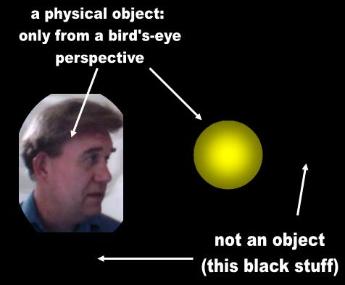
| The Object Bill |
| but only from a distance |
Fig. 1 Object |
- Module main page: After 3000 years, the idiots of Philosophy cannot tell you what an object is!
Pages in this module:
1. The ultimate subject matter of a scientific dissertation must be a physical object
2. Is an object a bundle of properties?
3. Is an object a substance?
4. This page: What really is an object?
5. The philosophers voice their objections
| An object is that which has shape. It has shape irrespective of observers known as mathematicians. Physics relies on neither witnesses nor testimony. From an observer's perspective, an object can only be visualized from a distance. So, now, what is the distance between you and space-time or a black hole if neither has a surface? |

- ________________________________________________________________________________________
- Copyright © by Nila Gaede 2008