1.0 Predicting the past
In his debate with Sagan, Mayr unjustifiably emphasizes tactical over strategic factors. He momentarily assigns little
weight to gravity, distance from the Sun, climate, and environment – to the grand scheme of things – and too much to
behavior and interactions with contemporaries. Perhaps he reasons that since primates could have acted differently
at a crucial moment in time or faced different opponents, the appearance of hominids was a stroke of extraordinary
luck. The question thus reduces to whether tactical, free will factors have the power to overcome strategic,
deterministic ones. Was Man like a bird, free to wander wherever he wished, or was he like a prisoner who paces from
wall to wall within a cell? Did Man really have a choice in being born?
I begin by pointing out that Mayr’s reasoning is in the negative. He is not foretelling what would have been, but what
would not have been. This is like saying that the dog would not have bitten you if you hadn’t walked out of your home
today. He can make such a prediction because he is speaking about consummated events. Mayr already knows what
happened and is simply regurgitating the events in the context of an afterthought. A true prediction is telling us what
would have happened if you stayed at home. Of course if you had stayed at home, the possibilities are endless. You
could have overslept. You could have gained two pounds eating. You could have slipped and fell in the bathtub.
What sense does it make to ponder what could have been in retrospect if you had done something else earlier. The
movie has already been made and is being shown at theatres. It's too late to predict what the actor 'would' have done.
But let's see if his 'prediction' reasoning has any merit. Once life develops, can we narrow down the possibilities?
Can we 'predict' (i.e., explain) how the animals that ever lived on Earth came to be?
- 2.0 Strategy is superior to tactics
On our beautiful blue planet the majority of guests have a choice of three habitats: air, land, and sea. Assuming that a
distant planet also offers these environments, what classes of plants and animals can we expect to develop that we
don’t already have on Earth? Wouldn’t animal life on this world also consist of insects, dinosaurs, reptiles, birds,
mammals, amphibians and fish? Wouldn’t animals develop fins, gills, tails, ears, mouths, legs, and wings to swim,
crawl, fly, run, hear, and eat? Wouldn’t there be predators and prey, Lilliputians and giants, viruses and bacteria?
Wouldn’t these species and classes also develop brains?
More significantly, we can argue that it was predictable that you would leave the house because you had to go to work
as you do always. You could have stayed at home but the likelihood was nil. We could not have predicted everything
that would happen, for example, that a dog would bite you. But there are some things that we can form an intelligent
guess on if we have sufficient data. If you always leave home at 8:00 in the morning to go to work, and you have done
the same thing for 10 years, it is a good guess for an impartial observer to predict that tomorrow you will do the same.
The observer can probably succeed at guessing that you will leave home. He will probably not be able to predict that
a dog is going to bite you even in the case where he has information about a dog being loose in the vicinity.
Chip manufacturing again comes to the rescue to answer these kinds of questions and to show the supremacy of
strategy (determinism) over tactics (free will). The word ‘yield’ is used in the semiconductor business to refer to the
ratio of functioning to total chips on a wafer. After undergoing hundreds of steps, the wafers come out of the line
with yields of over 80% or 90%. This means that, on the average, most of the chips on a wafer will be good. The
engineers can also 'predict' that the die on the edges of the wafers will come out bad for different reasons (handling,
design, temperature uniformity, etc.). But how can this be if the delicate, paper-thin wafers are subjected to physical
pummeling for several weeks inside machines that shuffle and heat them? Almost anything can go wrong at any
time, and sometimes entire lots are canned for mishandling. Yet again, against impossible odds, the overwhelming
majority of wafers and most chips within a wafer come out right.
Integrated circuit production yields are useful to illustrate the difference between strategic and tactical factors. Strategy
(determinism) differs from tactics (free will) in that the former is planned whereas the latter is improvised. A strategic
factor is a planned or known entity or event that affects the outcome of the experiment. Strategic factors go hand in
hand with determinism. They include climate, distance from the Sun, size of the planet/gravity, contemporary plants
and animals, the environment, how far a species is from food or water, the tenuity of atmosphere, etc. A tactical factor
is one that is improvised on the run. A tactical maneuver is a last minute occurrence or intuitive behavior. In the context
of evolution, tactical factors comprise those short-term parameters such as eating and mating habits, development of a
particular physical attribute, reacting to predators or prey, etc. Despite being spontaneous, natural catastrophes or
comet collisions do not qualify as tactical because they don’t involve conscious decisions. They are unplanned only
in the sense that we don’t know about them and thus don’t factor them in our calculations. The issue of whether they
are strategic is then an issue of information. In general, we cannot predict tactical maneuvers because they are
behavioral. We have a better chance of predicting those that are planned.
In semiconductor processing, planned factors are those that limit the extent of damage to the wafers. These include
the general cleanliness of the fabrication room, machine tolerances, fabrication specifications, and operator training.
For example, by limiting equipment performance, the manufacturer guarantees the maximum amount of damage a
wafer can receive or the number of wafers that can receive unexpected punishment. Tactical factors are mostly related
to handling. Self-interest (desire to have good chips, writing good process specifications, operator training) is what
ensures that handling errors are reduced to a minimum. Therefore, despite that handling is an important factor in the
manufacture of wafers and much can go wrong, most of the chips are functional when they come out of the conveyor
belt.
Strategic factors are likewise more important than tactical factors during evolution of species. As a minimum, life as we
know it seems to require at least carbon, nitrogen, a few other elements, a specific range of temperatures, and a certain
planet size. When we theorize about whether Man would evolve again, we must assume that the strategic factors are
left undisturbed. It would make no sense to speculate about the re-appearance of Man and assume that an asteroid is
on a collision course with Earth. When we ponder whether intelligent beings evolved in other planets, we do not
destroy the planet with a collision before we carry out the gedanken experiment. On the contrary, we assume favorable
initial conditions to see the process in best light. We are not trying to discover whether Man can make it if we destroy his
planet. We are trying to determine whether Man reappears all else being equal. We assume the same strategic parameters
that we have on Earth: mass/gravity, distance from and size of the Sun, atmosphere, tilt, spin, magnetic field, etc. If we
place the planet at the distance of Pluto or assign a mass like Jupiter’s, we guarantee that human-level intelligence will
not develop. In the context of Mayr’s statement, we are trying to find out if Man would evolve again had all else been
equal. The question comes down to whether we know the factors that were necessary to create Man.
- 3.0 Strategic factors leave little room for miscprocessing
Therefore, the first question is whether we can guarantee that life will form if we keep the initial strategic factors. The
intuitive answer is yes. One would think that, like the equipment of a chip fabrication area, the ability of this relatively
stable system to permit out-of-spec excursions is somewhat limited. If Urey’s life experiment proved something it is
that, given a range of temperatures, gravity, chemicals, spark, etc., amino acids will inevitably form. In a similar vein, if
we carry out an experiment with an Earth-like planet, we should expect a similar evolution towards life irrespective of
what each individual atom in the atmosphere ‘decides’ to do. The strategic deterministic parameters by far outweigh
the tactical free will options. If the devil’s advocate postulates that land never rose above sea level for animals to crawl
onto it, then we are not assuming an Earth-like planet blessed with volcanic and tectonic activity. We are again
amending the strategic factors.
Animals are products of their environment. If we concede as givens the very broad strategic ones such as climate,
mass, land, chemical elements, the next step is to factor in the tactical ones. Tactical factors may include, for instance,
the relation an animal develops with other animals and with plants. However, plants also have long term strategic
plans which overrule petty free will options an animal may have. One major strategic path taken by plants is their
development of sexuality. Plants went from spore reproduction to cones to encased seeds in a period of millions of
years. Different classes of animals developed along the way in relation to the plants in their particular era. You could
argue that a horse has free will and should be able to eat bark instead of grass. After all, plants are just plants. The
question is whether the strategic deterministic factors (whatever induced horses to eat grass in the first place) can
be overruled by whim. Do you perchance eat weeds or pine tree leaves when you run out of lettuce and tomatoes?
In other words, the geological history of plants is a chronology of their sexual evolution, and the grand evolution of
quadrupeds runs parallel to plant chronology (Fig. 1). If it is true that animals are a function of their environment,
these general categories were inevitable. What other category can a four-legged terrestrial animal fit into if not
amphibian (frogs, salamanders), reptile (turtles, crocs, lizards), pelycosaur, dinosaur, or mammal. Coincidentally,
these broad category of animals are also differentiated usually because of their reproductive habits. The amphibians
have tadpole (non-amniotic). The reptiles, pelycosaurs, and dinosaurs, have eggs, and the mammals have converted
the egg into a placenta.
| Mammals were inevitable |
| Adapted for the Internet from: Why God Doesn't Exist |
- ________________________________________________________________________________________
- Last modified 03/03/08
- Copyright © by Nila Gaede 2008
Fig. 1 The Big Picture: The history of terrestrial plants and tetrapods |
| Theistic Evolution |
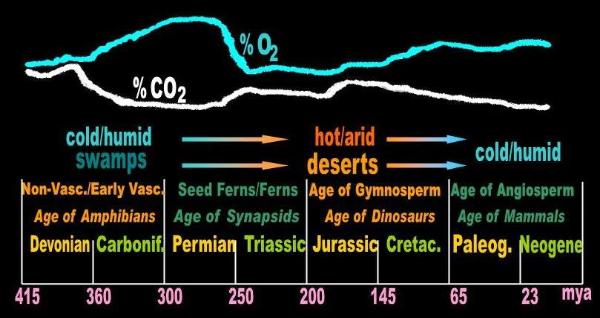
| This chart is a very broad generalization. It shows that specific types of 4-legged terrestrials are associated with specific types of plants. The history of plants is essentially a history of their refinement of reproduction. It goes from non-vascular plants, which reproduce by gametes, to spore reproduction, to gymnosperms, which reproduce by seed, to angiosperm, which reproduce by encased seeds. This excruciatingly slow evolution took millions of years. It suggests that angiosperm (flowering plants which are the current rulers of the green world) were inevitable. A broad category of animal species is associated with a broad category of plants. If we look at the history of herbivores as a function of the plants they ate, the mammals were as inevitable as the angiosperm that now dominate the land. |
- Module main page: Do UFOs exist?
Pages in this module
1. Life requires tight specifications
2. All living entities developed intelligence
3. Humans were in the cards
- 4. Stretching is free will; a long neck, determinism
5. Analysts invoke both free will and determinism to justify their theories
6. This page: Mammals were inevitable
7. What do intelligent ET aliens look like?
Once animals appeared on land, it was predictable that they would specialize into predators and prey, herbivores and
carnivores, big and small. Could something have changed the course of events?
Barring strategic factors, again, we have to conclude that the deterministic factors (long term interrelations between
plants and animals) would likely outweigh any free will decision made by a lonely animal. An animal would have had a
very short range of options. It would not have been able to change its diet overnight even if it wanted to. It would not
have been able to have offspring in a different way. It would not have been able to experience relations with other types
of animals at its discretion. And so on.
4.0 What do you call a mammal that eats grass?
What kind of animals would have developed if not what we see in the fossil record? Would they have been cubic or
triangular? Would there have been dinosaurs walking on 10 legs or fish with 5 paddles?
Well, let’s assume we take a very long trip through space. What kind of animal would we venture to guess developed
on land in another planet?
Contrary to popular belief it is actually quite easy to determine this. There are a limited set of distinct motions available
to land animals. They can slither, crawl, roll, jump, walk, run, and gallop. Perhaps I missed a few, but there are not that
many more options. We must conclude that whatever animal thrived on land would have had to eventually develop
extremities. Some animals developed 6 legs; others, like the snake, developed none; and still others, like the centipede,
developed more than most animals need. But the majority of animals, especially the large ones developed four. However,
my argument flows in reverse. What if you go to another planet and see an animal that runs on four legs and eats grass?
What should you call it? Or perhaps I should word the question backwards. If we remove the amphibians, therapsids,
therodonts, thecodonts, dinosaurs, and mammals, or alternatively the anapsids, synapsids, and diapsids, what other
general types of 4-legged creatures can we expect would develop on another planet? What else can we call a vertebrate
that gallops on 4 legs, has a head with a brain and two eyes, and either lays eggs or carries babies in the womb? What
should we call a plant that bears spores or cones or seeds? If we remove the algae, the non-vasculars, the gymnosperm,
and the angiosperm, what other forms of reproduction can we hope for plants to have? Again, these categories have to
do with definitions and not with imagining the morphology of plants and animals in distant worlds. The more a planet
resembles Earth, the tighter the tolerances, and the more likely that plant and animal morphology and behavior is
consistent with our experience. It can be no other way because the general categories of plants and animals on Earth
are a product of their environment.
5.0 Could the dinosaurs have lived before the pelycosaurs?
The next question we have to answer if we stick with these assumptions is whether the broad category we call mammals
were inevitable. A vertebrate is classified as a mammal if it has mammary glands, hair or fur, and a warm-blooded body.
We use this category to distinguish it from other classes of animals such as reptilia, insecta, or aves. For instance, it
could be argued that the dinosaurs were not necessary. However, this theory implies that we know the process that
manufactures a man. Perhaps the Age of Dinosaurs was what enabled tiny mammals to perfect certain abilities that
would become important after the dinosaurs' demise. Certainly, we weren’t ready to take over the world yet. Mammals
had not developed to large sizes. The plants we needed to fuel our expansion were certainly not there. And there were
other more subtle features that we were still working on. One Cretaceous mammal, Alphadon, had fewer bones in its
jaws. An extinct branch known collectively as multituberculata had a distinct pelvis and many cusped teeth. And
certainly we cannot deny that there is a close relation between plants and animals. In the same way that we had to wait
for the dinosaur/cycad cycle to run its course they had to wait for the earlier therapsid/ fern cycle to run its course. Can
we perchance imagine cows and zebras in an Age of Cycads? How about horses chewing ferns and horsetails in the
Carboniferous? Obviously, the tiny shrew-like creatures that apparently were our ancestors had to wait in the wings for
certain things to happen. Once the dinosaurs were out of the way and particular plants appeared, then it was our turn
to become the rulers of the planet. This suggests that the broad branches of the animal and plant kingdom were in
retrospect 'predictable' (i.e., we can explain why they came to be). We cannot even conceive of triceratops in the
Devonian or diadectes living in this day and age. These animals were a product of their environment. They were meant
to be at a specific time and not because there is an intelligent hand that guides the process. They were meant to be
because they had to develop certain features that were inherited by subsequent species in an uninterrupted line of
succession stretching from the Pre-Cambrian to the present.
Mayr insinuates that anything could have happened along the way. Maybe if the dinosaurs continued to be around, we
wouldn’t be around. Or maybe mammals could have preceded the dinosaurs and the dinosaurs could have preceded
the primordial cell.
Many in the establishment live with this faulty reasoning. A more correct version is that, if the animals that exist at any
particular point in time are a result of the plants existing at that time, the dinosaurs were as inevitable as the mammals.
The major trends in animal and plant life do show a pattern. The person who denies this is simply unwilling to face the
truth. If there is a trend, there is a measure of determinism, of ‘explainability.’
- 6.0 ...and then God made monkeys out of us
The last question is whether primates would have inevitably developed. In order to manufacture a primate, we absolutely
need trees. If we go to a planet that has no trees, we are sure to find no hominids. What chances would an animal like a
monkey have on the savannah against a lion? What would he eat if not grass side by side with wildebeest and giraffes?
A monkey on the plains is as good as extinct, or in the alternative, must quickly become just another fast, four-legged
herbivore or carnivore.
Therefore, the question really is whether trees were inevitable. The record shows that trees developed almost from the
beginning, certainly in the Carboniferous. When they did, the animals that took to the trees developed fantastic powers.
For example, the dragonflies of the Carboniferous fern forests and the birds of the Jurassic conifer forests developed
flying. One theory is that they learned to glide from the branches. Hence, there is no reason to assume that the more
advanced angiosperm would never have developed a franchise known as trees. In order for angiosperm to develop,
Mother Nature had to give them time. She had to wait for the dinosaur/cycad phase to run its course. The plants could
not have made the transition from vascular to angiosperm in just a handful of million years while bypassing the
gymnosperm phase. The plants were refining the mechanism of reproduction. Indeed, the dinosaurs had to help us
wipe out the cycads and cycadeoids before the angiosperm could take over. Mother Nature required them to clean
up their mess before they left. We are faithfully doing the same. We are wiping out the forests, replacing weeds with
corn and wheat, paving the land, and building skyscrapers. This will probably become the home of the Kingdom of
the Insects that is likely to rule when we're gone.
Hence, the transition from non-vascular to gymnosperm to angiosperm was in retrospect also 'predictable.' When
angiosperm appeared, the tree was just a matter of time.
What do we call a four-legged vertebrate that carves out a niche in trees?
By definition, it is a primate. This type of animal is sure to develop dexterous hands for grabbing and good eye-hand-mind
coordination.
