| Adapted for the Internet from: Why God Doesn't Exist |
Not everyone will agree with shape as the sole criterion. Plato, for one, argued that true form is not the malleable shell of
real objects, but an underlying essence approachable solely through philosophy. This Greek moron was saying that you
don't visualize objects. You're supposed to understand them. It is not the cube that is real. It is its shadow -- a concept --
which is the genuine object:
- “ Will he not fancy that the shadows which he formerly saw are truer than the objects
which are now shown to him?” [1]
Plato argued that a boat is an idea long before the builder builds it, and if the contraption fails to float it is questionable
whether we can even call it a boat, let alone an ideal one. Plato proposed that a genuine object must be ideal. Imitations
are not as good as the Real McCoy. In his opinion, everything you see or touch, including yourself, are mere shadows
of real objects that exist somewhere in heaven. The real, ideal boat is the one the angels row, the one you 'planned' to
build. That beautiful sail boat you took out last week… that’s just a mirage, especially if it had a stunning blonde in a
bikini in it. You were just dreaming:
- “ [Plato] saw the perceptual world, and the things in it, as imperfect copies of the intelligible
forms or ideas.” [2]
Elder is one who seems to agree with Plato. He believes that this boat would not exist if we replaced a single nail in it:
- “ objects which could not possibly have any parts other than their actual ones, nor any
size other than their actual one, simply do not exist” [3]
A related argument has it that the words we use to designate objects are themselves artificial concepts. While tree
designates an object, it is itself a concept and may be used in the context of abstractions. How, then, do we
distinguish between the word and the ‘substrate,’ between the clay and the statue, between the ideal and the real?
Which in each set can truly be said to have form? How do we go about using the word object consistently in a
scientific setting?
Of course, Plato had a bunch of screws loose in his head and so do his disciples. Unfortunately, I must concede
that most of his ideas seeped into the mainstream and have had great success over the centuries. By far, most people
have always leaned towards supernatural explanations and believe in physical interpretations which violate what
Father Universe can do. They arrive at similar misconceptions as Plato about what an object is. Religious folk are
sure to find their best exponent of their faith in Plato.
So let’s look at Plato’s claim and see if his idiotic proposal has any merit. If a boat is an idea before we build it or it
fails to float, does the word boat not designate an object? Or if we replace some of the boards on a boat and we
disagree as to whether we have the same boat as before, does this in any way change the status of the word boat?
Obviously, the word boat refers to ‘something’ irrespective of whether it floats, is yet to be constructed, or is missing
a nail. The word boat represents ‘something’ the prosecutor can point a finger at and identify with a sound. A boat is
a ‘thing’ from conception, through construction, to the moment it comes out of the shipyard, whether in perfect or
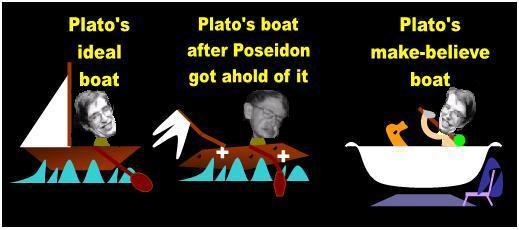
imperfect form. We can even dare to call a bathtub a boat and it wouldn’t matter in the least (Fig. 1).
| Plato says that an object is that which is ideal |
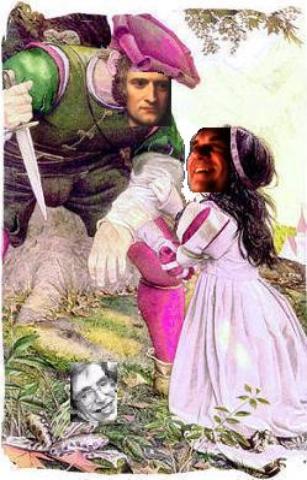

| If you repeat one more time that my dream girl looks like a frog, I swear I'll cut you to pieces! |
Fig. 1 Plato’s ideal boat |
Whether ideal, real, broken,
missing a piece, or imaginary a
boat is an object. The word
boat does not become a
concept until it is used in a
sentence. Until then the word
boat only refers to a shape. It is
a word attached to a shape that
you can point your finger to.
missing a piece, or imaginary a
boat is an object. The word
boat does not become a
concept until it is used in a
sentence. Until then the word
boat only refers to a shape. It is
a word attached to a shape that
you can point your finger to.
- Module main page: Is an object a bundle of properties?
1. Frege says that a variable is an object
2. Russell says that an object is that which is one
3. Lavoisier says that an object is that which cannot be destroyed
4. Newton says that an object is that which has mass and occupies space
5. This page: Plato says that an object is that which is ideal
6. Bohr says that an object is not an object without an observer
7. Elder says that an object is that which is made of parts
- Now, whether this boat exists depends on whether it has location. Does this boat have an independent surface separated from
other surfaces in the Universe? If so, it exists by definition. Whether it is missing a board or a nail is irrelevant to its existence.

- ________________________________________________________________________________________
- Copyright © by Nila Gaede 2008