| Adapted for the Internet from: Why God Doesn't Exist |
The contemporary philosopher does not spend his valuable time defining petty words such as object and existence anymore.
That's below his dignity. What he does is move on to the theory stage and use these words without having any idea of what
he is talking about. As a result, the morons of Philosophy go around and around for hours arguing about stuff that would put
you to sleep in seconds. The two most ludicrous subjects of contemporary Philosophy are mereology and temporal parts.
You don't want to miss the seminar...
- 1.0 Mereology: the 'science' of physical parts
Elder defines different degrees of subcomponents of objects he calls parcels, hunks, and masses. [1] His view of the nature
of physical objects is shared by his colleagues:
- “ Mereology is the study of part-whole relationships of objects.” [2]
“ It is uncontroversial that physical objects are typically extended in both space and time…
Spatial extension is normally thought of as necessarily involving different spatial parts
at different locations in space… A bicycle, for example, can be extended across a doorway
in virtue of having some spatial parts inside the doorway and other spatial parts outside
the doorway.” [3]
[Uncontroversial? He’s gotta be kiddin’ me!]
“ In mathematics, a singleton is a set with exactly one element. For example, the set {0} is
a singleton. Note that a set such as {{1,2,3}} is also a singleton: the only element is a set
(which itself is however not a singleton).” [4]
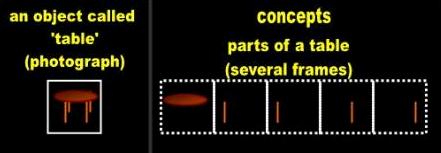
Now you have a feel for how the Mathematicians and Philosophers end up chasing their tails around in circles. The table is
one, they say, but the revisionist comes in and says, ‘Ah, but it is made of 4 legs and a board, so the set is comprised of 5
elements.’ (Fig. 1) And then the chemist comes around and adds that, although the leg is one, it is also made of carbon
atoms. Therefore, this set is also one, yet it is comprised of gazillions of elements. It never stops with the idiots of
Philosophy.
So what can we learn from the stupid morons of Mathematics and Philosophy? They haven’t made any progress in
knowledge since Plato and Aristotle debated the same issues 2000 years ago! The only thing you learn about
mereology is that after 2000 years, the philosophers are back to square one, questioning the monad/unity theory of
objecthood:
- " Mereology (from the Greek μερος, ‘part’) is the theory of parthood relations: of the
relations of part to whole and the relations of part to part within a whole. Its roots
can be traced back to the early days of philosophy, beginning with the Presocratic
atomists and continuing throughout the writings of Plato" [5]
Is an object one or many? I don't know. Why don't we ask the philosopher over there? He studied Plato and Aquinas
and Kant and Wittgenstein. He should know!
| Elder says that an object is that which is made of parts |
3.0 Conclusions
The mathematical philosopher has failed to do the basics: define the words object and exist unambiguously. Yet here he is
at the next level discussing 'temporal' and 'mereologic' objects. For the purposes of Science, an object is something we
point to. The instant you point to a table, the jury is not pondering what it's made of or how it is constructed. For the moment,
the jury has its hands full attempting to match the sound you pronounced with the image they're visualizing. Understanding
the concept table comes later when you describe the object or explain what it does or is used for. For the purposes of
Science, a table, a chair, a rock, a tree are all made of a single piece. Here again we confirm that 'divisible' and 'countable'
are experiments carried out by extrinsic ‘objects’ known as idiots. Idiots are mathematicians and philosophers who
perennially run real and gedanken experiments in an effort to prove definitions.
Mereology and the study of temporal objects are sciences like astrology is a science. The morons of Philosophy invented
this poppycock to find something to do with their valuable time. Predictably, they sought guidance from the mathematicians,
whom they look up to and treat as if they were gods:
- " things have temporal parts as well as spatial parts: accepting this is supposed to help
us solve a whole bunch of metaphysical problems, and keep our philosophy in line
with modern physics." [10]
What more needs to be said?
Fig. 1 |
An object is conceptually a static image.
It involves neither parts nor time, but only
a single frame in the universal movie.
A concept is a movie. This movie may
consist of the parts of an object (intrinsic)
or of the perceptions of an observer
(extrinsic).
It involves neither parts nor time, but only
a single frame in the universal movie.
A concept is a movie. This movie may
consist of the parts of an object (intrinsic)
or of the perceptions of an observer
(extrinsic).

| Newt? I'm not sure I can support you any longer. I think I'm beginning to fall apart. |
- Module main page: Is an object a bundle of properties?
1. Frege says that a variable is an object
2. Russell says that an object is that which is one
3. Lavoisier says that an object is that which cannot be destroyed
4. Newton says that an object is that which has mass and occupies space
5. Plato says that an object is that which is ideal
6. Bohr says that an object is not an object without an observer
7. This page: Elder says that an object is that which is made of parts
2.0 Temporal parts
The contemporary Philosophers endlessly discuss whether an object now is the same as the object before or whether we
see its front before its rear. This 'science' is called the study of temporal parts. Yes, like mereology, temporal parts is an issue
founded upon observers. Without a witness, Mathematical Physics and its sidekick Modern Philosophy, are dead. The
mathematical philosophers have made the definition of the word object contingent on what a witness perceives and not
on what it is on its own. It is by introducing a witness that the mathematical philosopher has enabled time to penetrate
the definition of object:
- “ What does it mean for an object to be the same, if it changes over time?” [6]
- “ On The 4D View, objects are to be thought of as four-dimensional 'space-time worms,'
each of which is made up of many different temporal parts, like the different spatial
segments of an earthworm. An object at a time -- Descartes in 1625, for example -- is
not the whole object but, rather, a mere part (a temporal part) of that object; and the
relation between Descartes in 1625 and Descartes in 1635 is like the relation between
the two wheels of a bicycle: they are different parts of a bigger whole.” [7]
[Yes folks! You are paying for this guy's salary!]
- One 'mathematical object' the philosophers borrowed from the other side of campus is the tesseract. The philosophers
found the tesseract to be 'useful' for their purposes, which is to continue having a job. They extrapolated this
misconceived concept into Philosophy and treat it like a physical object:
“ But what sort of thing must the object be in order to present itself in such different ways
in various perspectives without being different from itself? The answer can by now be
anticipated: the object must be four-dimensional, it must be extended in time as well as
space. It will then have different 3D shapes in different perspectives because such
shapes will be intrinsic properties of its 3D parts.” [8]
The popular view in contemporary Philosophy is that, in order for the observer to see a table, she needs time. It takes
time for light to reach her eyes and for her to process the information piece by piece. In contemporary Philosophy, like
in Mathematical Physics, a relativist may have his feet on Tuesday and his head on Wednesday! Due to quantum
uncertainties, you never know for sure whether your pillow just happens to sit on one of those nasty wormholes that
pinches off your neck and lobs the head into the future. In Mathematical Physics, anything is possible! That’s why,as
a preventative measure, I always recommend that relativists and mechanics sleep vertically on the 29th of February
since it might take them four years to recover their heads should they happen to sleep on a temporal fault line.
The box Balashov constructs ‘through’ time by scanning a plane is neither a physical object nor a volume. [9]
Balashov is talking about a movie of a plane in motion. A square moving through the air does not result in a cube. It
results in a single square pictured in the last frame of the movie. The relativistic philosopher tries to sound like an
intellectual by babbling in relativity and really ends up looking like a fool. The philosopher confuses a volume for a
solid and, more fundamental yet, the technique for arriving at a volume (i.e., integration) for the volume. You don't
'extend' in time as Balashov proposes. Extend we extend a bed sheet. The movie of this process takes up several
frames on the film. In each frame we see a single image of the sheet at different lengths. We do not aggregate these
images and build a white hay stack with them. We don't stretch the life of a man uninterruptedly from cradle to grave
and say that the result is four-dimensional man. Like all philosophers who gawk when they hear about relativity,
Balashov uses incongruous, unscientific language to express his ideas.
More appalling when you analyze modern Philosophy is the realization that this is the nonsense the philosophers
spend their time on. This is what you're paying for indirectly with your tax dollars.

| I'll prove to you that wine is a temporal object. Pour it in! |
|
For the purposes of Science, a table is
an object only when you point to it and
say 'table.' As soon as you do anything
with a table, for instance, when you use
it in a sentence, you summarily convert
it into a concept. You are no longer
alluding to the object table, but using it
in a relational context.
The moron of Philosophy claims, instead,
that as you walk through the door, the
an object only when you point to it and
say 'table.' As soon as you do anything
with a table, for instance, when you use
it in a sentence, you summarily convert
it into a concept. You are no longer
alluding to the object table, but using it
in a relational context.
The moron of Philosophy claims, instead,
that as you walk through the door, the
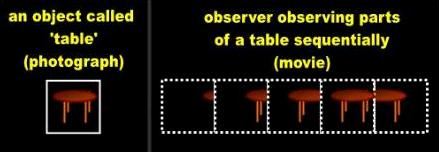
table appears in your eyes gradually, in a sequence of images, every piece of which is part of the table.
This nonsense constitutes what the idiots call a 'temporal object' (i.e., a movie of you seeing the table
in parts). Therefore, without having defined what they mean by 'object,' the bird brains are already
dividing it into spatial as well as temporal parts and discussing the merits of these views for hours at
your expense.
This nonsense constitutes what the idiots call a 'temporal object' (i.e., a movie of you seeing the table
in parts). Therefore, without having defined what they mean by 'object,' the bird brains are already
dividing it into spatial as well as temporal parts and discussing the merits of these views for hours at
your expense.

- ________________________________________________________________________________________
- Copyright © by Nila Gaede 2008