| Adapted for the Internet from: Why God Doesn't Exist |
| The mechanics say that a particle carries a force! |

| Ordinary people like you Bill don't understand what we mean in Quantum when we say that a particle 'carries a force.' Let me show you what we really mean. |
- QM postulates that particles carry forces
Like other cults of Mathematical Physics, the mathematicians of Quantum Mechanics were compelled to
develop incongruous language in order to convince each other and the world that they could explain reality.
Perhaps the most important term of QM is force. The word force is to Quantum Mechanics what space-time is
to General Relativity and time to Special Relativity: the bread and butter of the theory. Without force, QM is
bankrupt. Therefore, we have to get to the bottom of this strategic word if we are to learn anything about
quantum.
The cutting-edge Wolfram Physics site defines the word force like any ordinary dictionary: 'a push or a pull'.
I think that this definition suffices to get the idea of what normal people mean by force. No one in their right
mind confuses the verb pitch with the object baseball or say something stupid like that a baseball carries
pitch.
Therefore, it is perplexing to discover that Wolfram also proposes the existence of four particles that ‘carry’
forces, to wit: gravity, electromagnetism, weak, and strong:
- “ Force-carrying particles can be grouped into four categories” (p. 69) [1]
Did Hawking say ‘carry’? I’d like to think that this is a misprint, for how in the world can anyone conceptualize
particles carrying a force? Is an ant getting a free ride on a tennis ball?
- “ A theoretical particle having no mass and no charge that mediates (carries) the
gravitational force.” [2]
“ the graviton is a hypothetical elementary particle that transmits the force of gravity
in most quantum gravity theories” [3]
So I was not mistaken. The mechanics are saying that a force is 'something' that an ant carries like a backpack
(Fig. 1). The mathematicians are indeed saying that the tennis ball has a passenger. Is the term 'carry a force'
just a metaphor? If yes, what do the mechanics really mean?
Well, maybe I'm just a little sensitive about language. After all, Wikipedia does clarify that fundamental forces
such as gravity and electromagnetism are not really particles but ‘interactions.’ Thank God! I feel much better
now. For a moment there I thought that Hawking, et al., were saying that particles ‘carry’ forces. Silly of me! It
turns out that they really carry interactions, and sometimes charges, and others energy and momentum and…
- “ we call the particles which carry the interactions force carrier particles.” [4]
“ The photon is one of the elementary particles…, but they do carry energy,
momentum and angular momentum.” [5]
“ The fundamental particles of QCD, the quarks and gluons, carry a new form of
charge, which is called color” [6]
“ Gauge bosons are bosonic particles which act as carriers of the fundamental
forces of Nature.” [7]
Why would the mathematicians invent such contorted language to describe a phenomenon of nature? What's
the reason for this Ptolemaic explanation? Wasn’t it simpler and more accurate to say that a particle pushes
another than to say that it carries and then exchanges a force? Imagine telling the judge that you carried your
jump and unloaded it when your feet smashed the victim’s hand. He would lock you up and throw the key
away! Do you perchance say that you carry and exchange your jump? An analysis of the QM carriers shows
why it was necessary for the mathematicians to invent this ridiculous jargon.
Nevertheless, if it was easy to conceptualize how an outgoing billiard ball transferred its portion of push to
another, it was much harder to visualize how the incoming billiard ball transferred a chunk of pull to the 8-ball.
If Quantum has a weak spot it is that it runs into insurmountable trouble generating the force of pull with
discrete particles.
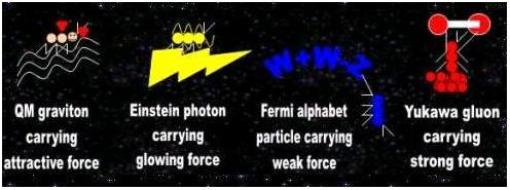
Fig. 1 Quantum ‘carriers’ of force |
The mechanics call these 'carrier' particles the graviton, the photon, the Ws/Zs, and the gluon. |
Module main page: The mechanics treat force as a physical object
Pages in this module:
- 1. This page: The mechanics say that a particle carries a force
2. In Quantum, there are 4 forces; in Physics, there are 2
3. A mechanics is an individual who never heard of the force of pull
4. The force of pull requires a physical intermediary
5. The force of pull requires a continuous medium
6. The force of pull is conceptually straight

- ________________________________________________________________________________________
- Copyright © by Nila Gaede 2008