| Adapted for the Internet from: Why God Doesn't Exist |
| The force of pull requires a physical intermediary |
- Can force be conceived without a physical intermediary or contact?
QM answers yes. One prominent example is the mechanics’ belief that the ‘electromagnetic’ force – light –
does not need a medium through which to propagate. However, light is an outbound force known as push.
What about pull? One enthusiast clarifies so we have no doubt:
- “ Contact forces require the physical contact of one object with another, such as a
hammer striking a nail or the force exerted by a gas under pressure, as when the
gas produced by exploding gunpowder forces a heavy ball out of a cannon. Field
forces, on the other hand, need no physical medium of contact” [1]
As always, the mechanics have no rational justification for such assertions. They just pull out their magic
wands and do it by decree. They are simply offering an irrational, surrealistic interpretation to a phenomenon
they can’t explain, especially with particles.
In Physics, forces always propagate through a physical medium. Otherwise, we don’t call it Physics. We call it
magic or Mathematics or something like that. In Physics, if you pull on the ends of a rubber band, you feel the
force of pull only until the rubber band breaks. Were this force to travel through space as the mathematicians
suggest, your hands would continue to feel a tug even after the rubber band rips. Or think of a spherical cage
made of metal gratings, such as a bingo tumbler. If we pull at opposite ends, the mathematician will say that
the force of pull manifests itself along an imaginary axis extending through the center of the cage. The
mathematician just averages out all the vectors. However, it is easily demonstrated that the force travels
through the wires (matter) constituting the tumbler (Fig. 1). For example, a canary flapping its wings in midair
inside the cage would not feel the composite of forces pulling through its belly. We verify this, in turn, by
cutting all the wires of the cage simultaneously without disturbing the imaginary axis along which the
mathematical forces would seem to propagate. The inertial force immediately ceases (and the canary will of
course fly free). There is no reason to believe that the ‘forces’ of gravity and light operate differently than the
contact force just described. We simply cannot rationalize pulling on nothing which pulls on something at the
other end. Such a proposal would fail at the conceptual stage and could never be experimentally certified.
Fig. 1 The cage or bingo tumbler |
Indeed, the notion that force is a vector (rectilinear propagation) is strictly a mathematical concoction. The
mathematicians don’t care if one atom pulls on another which then pulls on a third. This is Physics, and baby
stuff as far as a mathematician is concerned. The mathematicians are interested in net force. They want to
calculate and predict. They want to know in what direction and to what degree an object will move. The notion
of an imaginary axis is very convenient for this purpose, and this explains why, in Mathematics, force travels
through abstract axes, coordinates, and dimensions. In Physics, force is relayed through objects. Thus,
nowhere in the entire Universe does a force propagate rectilinearly. This surrealistic vision belongs
exclusively to Math.
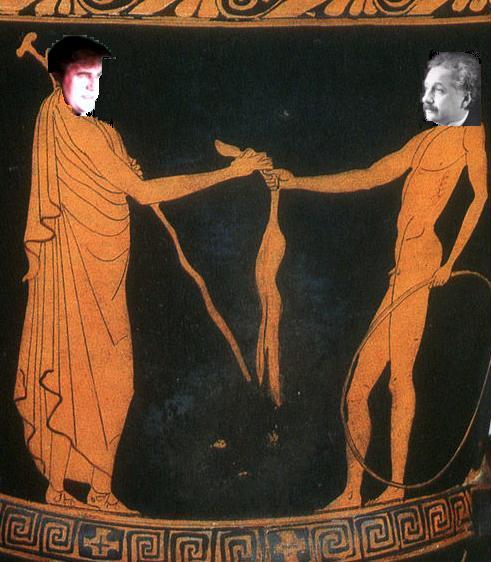

| Now let's see you pull without the tablecloth. |
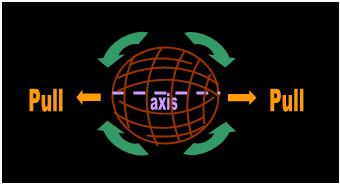
| The forces manifest themselves through the wires (matter), not through the imaginary axis (space). |
Module main page: The mechanics treat force as a physical object
Pages in this module:
- 1. The mechanics say that a particle carries a force
2. In Quantum, there are 4 forces; in Physics, there are 2
3. A mechanic is an individual who never heard of the force of pull
4. This page: The force of pull requires a physical intermediary
5. The force of pull requires a continuous medium
6. The force of pull is conceptually straight

- ________________________________________________________________________________________
- Copyright © by Nila Gaede 2008