| Adapted for the Internet from: Why God Doesn't Exist |
The wave fought the particle back with the same tenacity. In 1923, DeBroglie 57 developed an equation that would
resuscitate the dying wave theory, ironically, in the context of particles. DeBroglie discovered that the electron, like
the photon, also exhibits wave-like behavior and can be considered to be dispersed in an integral number of waves
around the nucleus of the atom (Fig. 3.22). The modern mechanics explain:
- “If we begin to think of electrons as waves, we’ll have to change our whole concept of
what an ‘orbit’ is. Instead of having a little particle whizzing around the nucleus in a
circular path, we’d have a wave sort of strung out around the whole circle. Now, the
only way such a wave could exist is if a whole number of its wavelengths fit exactly
around the circle. If the circumference is exactly as long as two wavelengths, say, or
three or four or five, that’s great, but two and a half won’t cut it.”
Davisson and Germer confirmed DeBroglie’s matter waves experimentally in 1925, when they demonstrated that
electrons reflected off a Nickel target also exhibited diffraction patterns. Until then, it was thought that only light
waves could produce diffraction. Schrodinger 60 improved on DeBroglie’s matter waves by developing equations
that allow us to determine the probability of finding an electron in a given region around the nucleus.
- “Wave functions are often interpreted as describing the probability of finding their
corresponding particle at a given point in space at a given time.”
| The ribbon atom! |

| The atom is like Saturn, Bill. It has a hula hoop permanently skirting its waist. More complex atoms have more hoops. |
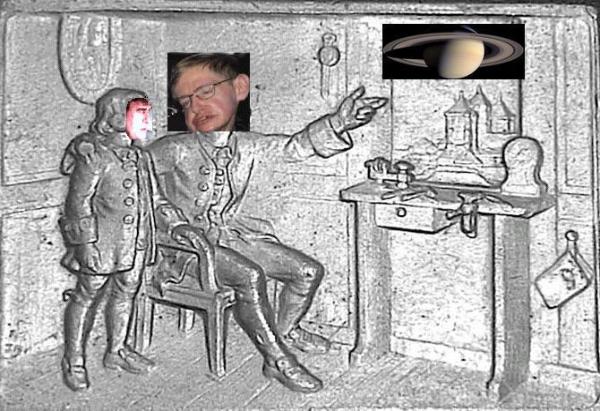

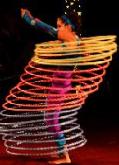

Fig. 3.22 DeBroglie’s Electron Waves |
| The electron doesn’t fall towards the nucleus as Thomson predicted because it also behaves like a wave. This electron has an integral number of waves and can occupy only a certain region around the nucleus. This model also simultaneously accounts for Bohr’s quantum jump and Thomson’s stability concerns. |
- Module main page: They don't call it Quantum Magic for nothing!
This page: The Quantum electron: a bead, a ribbon, AND a cloud all in one!
Pages in this module:
1. Niels Bohr's ridiculous bead (1911)
2. De Broglie's more ridiculous ribbon (1923)
3. Max Born's even more ridiculous cloud (1926)
4. James's Bonds: A day at the York Chemistry Lab (2008)
5. Cramer believes he has seen an atom

- ________________________________________________________________________________________
- Copyright © by Nila Gaede 2008