Routinely, you read in the literature that somewhere some researchers were able to photograph an atom, or an individual
electron, or an electron cloud.
These are lies. Big, fat lies propounded by gullible idiots! No one has ever seen an atom! Not a single particle numskull
working at CERN or SLAC or Fermilab has the slightest idea what an atom looks like.
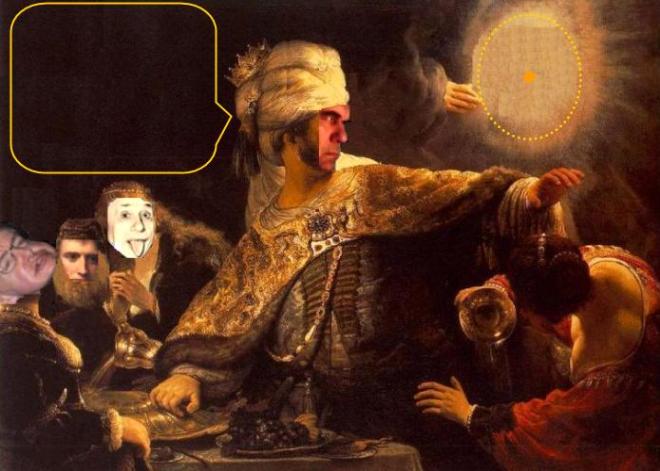
Cramer disagrees. Apparently he has seen an atom or a picture of one somewhere and was impressed:
- " Through the use of new 'trapping' techniques a quantum jump in an isolated single
atom has now been made visible to a human eye (slightly aided by a low power
telescope)… The idea that a nearly unaided eye can actually see a single atom is
quite remarkable in itself." [1]
- Another person who claims not only to have seen, but to have filmed an electron at a research center in Sweden is
Mauritsson. The people at his university boast that:
- " Now it is possible to see a movie of an electron. The movie shows how an electron
rides on a light wave after just having been pulled away from an atom. This is the
first time an electron has ever been filmed" [2]
And if you have doubts you can always watch the movie Mauritsson made of his electron in motion. [3]
So what is there to argue?
I suspect that Cramer and Mauritsson and the rest of them must be pretty gullible individuals. You could probably sell
the Empire State Building twice to them. If as Cramer and Mauritsson say, they have seen, photographed, and
interviewed an atom, they should have no trouble sketching one for us. And if they can really do this, they are truly
remarkable individuals. They would be the only persons in ‘Quantumdom’ to be privy to this knowledge. Perhaps
Cramer and Mauritsson would be willing to put their lives on the line and tell us unambiguously whether an electron
looks like Bohr’s discrete bead, DeBroglie’s integral ribbon, or Born’s cloud (Fig. 1)!
Of course, when you go check the sources of all these baseless claims, you find the wishy washy version of Quantum
Mechanics. You discover what enormous nonsense QM really is. The people in Sweden suddenly produce the fine
print on you:
- " scientists at the Lund University Faculty of Engineering in Sweden have managed
to capture the electron motion for the first time...We have long been promising the
research community that we will be able to use attosecond pulses to film electron
motion. Now that we have succeeded, we can study how electrons behave when
they collide with various objects, for example. The images can function as corrobo-
ration of our theories" [4]
Hold it! Did you say motion? I thought you said that you filmed an electron? Now it turns out you filmed its behavior.
How can you film its motion or its behavior if you don't know what the invisible entity looks like? Could it be that the
birdbrains at the Swedish university assumed that they were staring at a discrete particle? Perhaps the researchers
are confusing an assumption for a proof. Maybe these amateurs never learned the fundamentals of the scientific method.
Indeed, in one of the Swedish school's websites we discover that the 'scholars' work exclusively with abstract concepts:
- " We present how the generation of attosecond pulse trains can be controlled using
a two color driving field" [5]
[A driving field? I certainly hope that the field was not DWI!]
" trains of attosecond pulses "
[Is this train like a choo choo train?]
" When the attosecond pulses interact with a gas of atoms, electron wave packets are
created"
[So I was not mistaken! The researchers are saying that the pulses are physical objects
that have the ability to collide with atoms. We have a verb interacting with a noun. That's
great! But the funny part is that this interaction creates a verb-noun: a wave-packet.
Perhaps this wave-packet is what the researchers later filmed and called 'electron.']
" an energy exchange between the electrons and the field occurs"
[An energy exchange? How did they get this abstract concept energy to move?]
" when the electrons are injected... all the wave packets are injected"
[Aaaahhh! We finally arrive at the crux of the matter. An electron is really a wave
packet, which in turn is just an assumption. The mathematicians summarily
converted this assumption into a reality without allowing for dissenting opinions.
The famous electron that the Swedes filmed is an assumption: the assumption
that they're staring at the movement of a discrete particle. Of course, if what they're
watching is not a discrete particle or an extended wave, the claim to have been the
first to film an 'electron' flushes down the drain.]
[
- Whenever someone publishes a picture of an atom or an array of atoms and talks about beads swirling around, you
should ask them whether they are still in kindergarten. The ridiculous Rutherford and Bohr planetary models have
been categorically debunked. These models are used today to teach kindergarten children about the wonders of the
atom. The model college level people are supposed to be using is the more accurate valence shell model. Therefore,
anyone who talks about swirling beads needs to take Chemistry 101 or check into the nearest AA.
Allow me to run that by one more time in slo-mo in case you missed it. This is what the bead model of the atom should
look like if we took a picture of one (See force carriers, page three). Here's another example. Instead, all the pictures we

take of atoms or atomic arrays look like the following:


So let's compare again to make sure the idiots of Quantum understand. Here's an image of what people typically
imagine an atom to look like. This is the ridiculous planetary model Rutherford and Bohr came up with (and which
every professional of the establishment still believes in despite that they tell you it has been debunked). And this is
the more accurate 'orbital' version that mad scientists work in their dark basements with. Indeed, Clark tells us that
" Most popular science pictures of the atom show electrons moving around a nucleus
like planets around the sun. These pictures are quite simply wrong... Wrong, wrong,
wrong, wrong! The circles are NOT orbits. The electrons are NOT moving around the
nucleus along the circles." [6]
If we freeze an image of Mauritsson's bead orbiting we should see what Clark tells us that we shouldn't see. So which
model of the electron should you use to educate your kid now: Mauritsson's bead or Clark's orbital/cloud?
In fact, if ever Atom Man takes a close-up of an atom for us, it had better not look like what Mauritsson's team describes.
One individual tries to make a case for how the electron bead somehow can become continuous and cover the entire
atom like a shell:
- " To put it in a simple way, if you took a time lapse photo of a dripping faucet, what
would you see after a few million drips? Something a lot like a stream of water. This
is physically analogous (yes, insert your preferred analogy here, imperfect, blah).
Physics don't prohibit averages, or using average properties. The electron shell is
just an average property, and can be used happily that way in the right context.
This is a right context for that." [7]
- Not even close! Unfortunately this won't cut it. This mechanic is trying to sell you a whopper. He is saying that if a square
moves forward fast enough, we should see a cube in the photograph. This is the idea all mechanics have in mind when
they talk about orbitals and shells and clouds. The idea is that we are really watching countless contrails left behind by
a swift moving bead. The morons of the establishment are trying to tell you that you are staring at a collage: a bunch of
frames of a film superimposed on a static image! The bozos are selling you another of their emperor's clothes tales.
This is unadulterated bullshit! Not only would a bead have to make gazillions of orbits to paint an orbital, but this
nonsense pales next to the observation that orbitals interact to form molecules! The stupid idiots of Quantum Mechanics
go from orbit of one bead to a bunch of orbits they purport to call an orbital to the interaction of orbitals. They are now
tying two airplanes together by their contrails (Fig. 1)! This does require that I get another beer! Excuse me!
| JESUS! If that's your electron, it's absolutely stunning, guys! Your atom is all itinerary and no particle! |
J. Cramer, Watching The Quantum Jump, Alternate View Column AV-26 (Oct. 16, 1987). R. Sanders, First-ever images of atom-scale electron clouds in high-temperature superconductors could help in design of new and better materials, UC Berkeley (Feb. 16, 2000). J. Mauritsson, Attosecond Pulse Trains Generated using Two Color Laser Fields, Lund Institute of Technology (Aug. 8, 2006) M. Ford, Modified microscope views atoms at the edge of uncertainty, ARS Technica (Nov. 8, 2007). K. Lindgärde, Electron filmed for first time ever, The Swedish Research Council (Feb 22, 2008). |
Fig. 1 |
| Quantum proposes that atoms form covalent bonds when they get their contrails tangled. |

| See what you did you dummy! Now our contrails got tangled and we aren't going anywhere! |

| Adapted for the Internet from: Why God Doesn't Exist |
| Cramer believes he has seen an atom! |
- Module main page: The Quantum electron: a bead, a ribbon, AND a cloud all in one!
Pages in this module:
1. Niels Bohr's ridiculous bead (1911)
2. De Broglie's more ridiculous ribbon (1923)
3. Max Born's even more ridiculous cloud (1926)
4. James's Bonds: A day at the York Chemistry Lab (2008)
5. This page: Cramer believes he has seen an atom
- ________________________________________________________________________________________
- Copyright © by Nila Gaede 2008