Summary
The establishment has yet to define the word science unambiguously and has no clue regarding the purpose
of the scientific method. Closer inspection leads us to the center of the storm: the enigmatic word hypothesis.
The morons of science have misconstrued the meaning and purpose of the hypothesis, which they somehow
associate with the ability to make predictions. The worldly wisdom is that if experiment confirms the hunch,
the hypothesis can now be treated as a theory. And when the theory is approved by a show of hands, it now
becomes a fact.
In Science, we do things a bit differently. First of all Science is not in the business of making predictions. This
is the stuff of astrologers, charismatic evangelists, and mad scientists. And if we use Mathematics at all, it is
merely to reinforce a theory; equations are not a requirement of the scientific method. Mathematics describes.
Mathematics does not explain. Science is about explaining why, not about describing how.
Then, in Science, we don't test hypotheses. In Science, we formulate them and ask the jurors to take them at
face value. Assumptions, we formulate. It is theories that we test, if at all, and only after the presentation is
over. In Science, there is no requirement for an experiment. A hypothesis consists of exhibits, defini-tions,
and a statements of the facts. There is no provision in a hypothesis for Math or for experiments. The reason
a contemporary 'scientist' cannot tell you the difference between science and religion is primarily due to the
establishment's failure to define the term hypothesis 'scientifically' (i.e., in such a way that it can be used
consistently).
Of course, when we follow the correct method, an entirely different picture of the Universe emerges and you
realize that the mathematicians have wasted the last 400 years in worthless pursuits. Once we make the
correct assumptions regarding the nature of invisible entities and mechanisms -- light, the atom, magnetism,
space, gravity -- we are finally in a position to explain and understand why things happen. It is not the
theories which are important in science, but the hypotheses. A genuine scientific theorist should spend 99%
of his time brainstorming, researching, and developing his hypothesis, and the remaining 1% on his petty
theory.
- Module main page: Scientists don't know what Science is
This module: A relativist believes that a hypothesis is a prediction
Pages in this module:
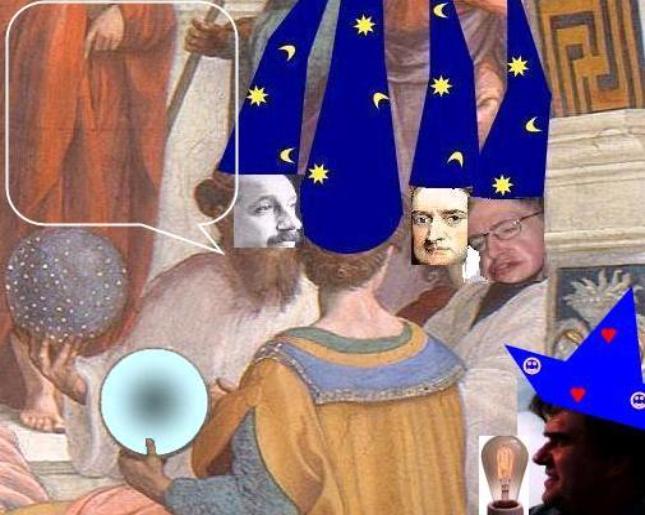
| This fellow’s crystal ball is no match for my opaque ball. My ball bypasses theories altogether and converts hypotheses directly into facts. |

| Should I bother these great men of science with my petty theories? |
| among the opaque giants at the Relativity Convention |
| Enlightened Bill |
| A relativist believes that a hypothesis is a prediction |
| Adapted for the Internet from: Why God Doesn't Exist |

- ________________________________________________________________________________________
- Copyright © by Nila Gaede 2008