| Adapted for the Internet from: Why God Doesn't Exist |
- ________________________________________________________________________________________
- Last modified 02/27/08
- Copyright © by Nila Gaede 2008
| The differences between |
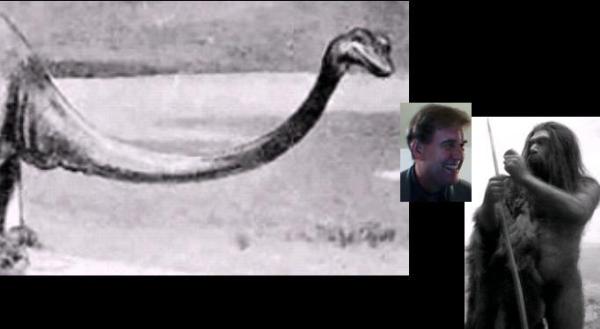
| a paleontologist |
| and |
| an anthropologist |

I have no idea, Bill!
I really don't know
I really don't know

| You're talking to the wrong guy, stupid! If you really want to know, ask me. |
1.0 The definitions of paleontologist and anthropologist
Normally, an anthropologist studies humans whereas a paleontologist studies prehistoric life forms. This is not how I will
use these terms here because it does not reflect reality. This site is geared for the average person. The layman has little to
no interest in whether an unpronounceable bone of the T-Rex anatomy was smaller than a comparable one of a
Giganotosaurus, or whether Neanderthal used Mousterian tools. These are subjects that concern specialists and a claque
of amateurs that follow the literature.
The only subject of any importance for the general public is extinction. People want to know if we have Neanderthal blood
in us or whether it is true that an asteroid wiped out the dinosaurs or whether Woolly froze or was hunted to death. Once
we answer these questions, we are done with Anthropology and Paleontology. The bone professionals need to look for
new jobs. The funds presently being diverted to resolve the extinction dispute dry up overnight.
Therefore, I will define paleontologist and anthropologist in terms of how they relate to extinction. And here there is a major
difference. A paleontologist studies the far past whereas an anthropologist studies the recent past. This confers upon the
paleontologist liberties denied to the anthropologist.
A paleontologist can publish any theory of extinction that comes off the top of his mind as long as it doesn't involve a human.
This gives him greater confidence when peddling his pet peeve. A paleontologist already knows what killed Dimetrodon 280
million years ago. It was a sudden climate change. A cold front came in and all the cold blooded creatures couldn't stand it.
Elementary stuff; a no-brainer. They also know without a shadow of a doubt what killed T-Rex 65 million years ago. It was an
asteroid. A gigantic rock collided with Earth, spread its debris throughout the atmosphere, and triggered an 'impact winter', a
long period where the Sun was blotted out. Photosynthesis was outlawed. Plants died. Herbivores died. Predators died. What
more is there to know? And thank God for that lucky stone, they'll add, for otherwise you wouldn't be around today!
The unfortunate anthropologist doesn't have it remotely as easy. There haven't been any major catastrophic accidents in the
last 100,000 years that could justify selective extinctions. A supernova perhaps? No sign of them! Excess volcanic activity?
Come oooon! Disease? Unlikely! There were no crowd diseases in those days! Climate change? Well this one together with
overkill enjoy popularity, not because they are true, but because the lay public has no trouble relating these mechanisms with
what we witness around us today. The point is that the amount of lies that an anthropologist can tell is not even a fraction of
those a paleontologist can get away with. Once in a while, you will hear an anthropologist confess that he doesn't know. You
will never hear those words coming from the mouth of a paleontologist.
- paleontologist: a person who knows exactly what caused ancient extinctions
anthropologist: a person who has no idea what caused recent extinctions
- 2.0 When the experts don't know
The paleontologists and anthropologists can tell you something about their specialized worlds, but you should put little to no
weight on their conclusions about extinction. The anthropologists can tell you how long a bone is and how it is different from
the one next to it. The same anthropologists will not agree on whether it belongs to a Neanderthal or to a Cro-Magnon. And
both the anthropologist and the paleontologist can at best speculate as much as you regarding the disappearance of T-Rex
or Woolly. Like the mathematicians, who have no authority to tell you anything about Physics, the bone diggers have as much
authority to tell you about extinctions as the next guy. They simply don't know!
So it is really tiring to see the media periodically interviewing anthropologists MacPhee and Martin to see what they have to
say about the extinction of the Mastodon, or publishing sensationalist headlines announcing something like 'New studies
indicate that Woolly may have been killed by disease' and then quoting MacPhee for the millionth time. None of the
anthropologists and paleontologists alive today have offered new insights for extinction in the last 30 years! None of them
have changed their minds and switched sides. You read them once. You read them forever.
You may suspect that the status quo has to do with insufficient data. The evidence is sketchy. The jury is still out. Therefore,
it's natural for people to draw conflicting conclusions.
You would be wrong. Four mtDNA and at least one DNA study show that Neanderthal has nothing to do with Man. So what
did the anthropologists whose religions and funds were suddenly threatened by these studies do? Again, they followed the
same procedures that their colleagues in relativity use. Unable to explain the galactic rotation problem which summarily
destroys relativity theory, the mathematicians invented dark matter. Now they spend your money looking for inexistent dark
matter in addition to inexistent black holes, inexistent wormholes, and inexistent dark energy. Likewise, the anthropologists
who lost the bet refused to concede defeat. The new argument is that mtDNA cannot really tell us anything about our relation
to Neanderthal. They could have told us before we spent all that money on the experiments. Instead, the scholars waited to
see if the results confirmed their theories.
- So where are we today? We are on wild goose chases everywhere, that's where we are! The experts who do mtDNA analysis
promise to do more studies, more carefully, at more cost to you, to resolve some time in the future whether Neanderthal and
Cro-Magnon really 'did it'. The experts who already made up their minds that the two species 'did' it are doing more bone
comparisons, at yet more cost to you, and arguing that Neanderthal was really no different than us. Sometimes I wonder
whether they are right and they do in fact descend from the Neanderthals.
Therefore, throwing more data at this problem is not going to solve anything. Extinction is not an issue of quantity, but of
quality. A recent pow wow held by contemporary Neanderthals makes this absolutely clear:
- " Nevertheless, despite the quality and weight of the evidence, there continue to be
major debates (that have lasted for 150 years) about a number of contentious issues,
especially whether or not Neanderthals should be included in the same species as
anatomically modern humans, and what is the precise phylogenetic relationship
between these two forms. Our inability to agree on these fundamental questions is a
matter of serious concern for paleoanthropologists: it leads to the inevitable conclu-
sion that if we are unable to come to a decision about the nature of the relationship
between Neanderthals and modern humans, how can we have confidence in our
ability to resolve relationships in the earlier, much more scanty, fossil human record.
However, the lack of unanimity is unrelated to the quality of the material. It is more a
consequence of deeper theoretical and conceptual issues that relate to how different
researchers analyze and interpret the anatomical and genetic evidence, and to the
manner in which these are ultimately situated in the broader context of how biological
systems operate in the natural world. If this is the case, then it will take some time
before a consensus can be reached, regardless of the amount of fossil material
available for study." [1]
So what is more data going to resolve? What is the purpose for people like Trinkaus or Martin to collect more information
at the lab or in the field other than to use it to push their theories? How many times do we have to read Martin's overkill
theory or Trinkaus's 'admixture' theory in Nature or in books, or watch a new documentary of the same theories on the
Discovery Channel? We have been investigating extinction for well over 100 years now and we keep repeating over and
over again, from generation to generation, the same theories and proposing the same agents.
What we need to do, without any further delay, is wipe the slate clean. We need to erase the board and start over. There is
something fundamentally wrong if at this late stage in the game with so much information at hand, we still don't understand
how 99% of the species that ever lived on Earth disappeared.
Don't get me wrong. By no means do I claim to be an expert in bones, hominids, or dinosaurs. My argument is that I don't
need to be. The fact that a professional went through several years of college and co-authored a bunch of papers in Nature
and Science gives them no edge over you on the subject of extinction. The matter at hand is not about jaws, femurs, or
Neanderthals. It is about logic, about the appalling state of science, and about personal religions. If the experts cannot
agree on the basics, if they cannot tell us unambiguously whether a bone belongs the Neanderthal or to Man, then they
are not experts in bones, let alone on the extinction of the species those bones allegedly represent. I don't care how many
years they warmed a seat at the university! We need to dispose of the notion that there are experts on the subject of
extinction.
What we need is new, rational proposals. This site aims to do just that. I propose two NEW rational mechanisms for the
extinction of species irrespective of habitat or epoch, one for background extinctions and another for mass extinctions.
Therefore, I can only speculate as much as the experts as to whether Woolly died in a background or in a mass extinction.
But if Woolly died in a mass extinction, I can describe the mechanism and tell you how it happened. Here, I will argue that
Neanderthal died in a background extinction. Now I'm going to tell you how it happened. Before I do, let's briefly review
what is wrong with current proposals.
3.0 Neanderthal died in a background extinction
The gut feeling among our sages is that Neanderthal sort of withered away gradually, peacefully. The mechanisms
paleontologists invoke to justify background extinctions are evolution, competition, new predators, and scarce resource.
These theories are popular because most people can relate to them. A lonely investor is trampled during the bull market
because he can’t compete against the heavyweights. The ‘law of the fittest’ they call it. The Neanderthals slacked off, and
faster, keener, or stronger animals (we) got the better of him.
However, we should step back and take a closer look at the reasons paleontologists brainstorm for background extinctions.
We know, for example, that we can remove scarce resources as a possibility right off the bat. When the Neanderthals started
their decline and to the very end, Europe was swarming with game. The scarcity of resources was not a show-stopper. We
can also rule out evolution. Evolve, Neanderthal didn’t evolve: we know of no other hominid hiding in bushes and in great
numbers. We are the last of the hominid dynasty, like Dimetrodon was the last of the finbacks, like Inostrancevia was the
last of the gorgons, like plesiosaur was the last of the nessies, and like T-Rex was the last of the great predatory land dinos.
This leaves competition and predation. Here, and until the next graduate proposes a new theory involving extraterrestrial
agents, we must conclude that Cro-Magnons were the only species capable of eliminating or crowding out the Neanderthals.
Unfortunately, this suggestion fails because Cro-Magnon was weaker, had carved out a different niche, and faced the same
climate. What other relation besides love and war could we have had with our cousins that would have exterminated them?
Hence, if we rule out love and war, we must conclude that we had absolutely nothing at all to do with the extinction of the
Neanderthal.
Let there be no doubt and let’s settle this once and for all: Neanderthal died all alone. He fizzled away into oblivion while
other species thrived and danced around him. This ‘selectivity’ is perplexing and does require profound thought. We will
not resolve this issue by searching for exogenous causes. We can only solve the problem with an endogenous cause.
There is a single endogenous cause that any species faces. That's what I will discuss here. However, before we talk about
how Neanderthal disappeared, it would be wise to review the contending theories and the justifications their main advocates
offer. This will enable us to establish a contrast between what they propose and the theory I will expose in this site.
- Module main page: Background Extinctions: How did Neanderthal and Woolly wither away?
Pages in this module:
- 1. This page: The differences between a paleontologist and an anthropologist
2. Stringer: The mighty hunter that caught a cold
3. Tattersall and Diamond: The Great Neanderthal-CroMagnon World War (40,000 - 25,000 B.C.)
4. Trinkaus and Wolpoff: How two top predators 'did it.'
5. Klein: Education is not what it used to be
6. Graham, MacPhee and Martin: Woolly got cold feet
7. So then, how did Neanderthal and Woolly disappear?
