1.0 Disease
Tattersall proposes that Neanderthal was a distinct species from cradle to grave. He suggests that
instead of sperm, Man passed on disease to his cousin. [1] Diamond is another one who speculates
that this may have been a cause of the Neanderthal's demise. [2] The experts have not yet discarded
disease, presumably imported by the unwitting invaders. [3] (Perhaps they watched Flintstone reruns
before writing their opinions.) We've seen this movie before. The Conquistador coughs and hundreds
of Aztecs drop like flies.
However, we cannot extrapolate what happened a few hundred years ago to Neanderthal because
Mother Nature had not yet invented crowd diseases. [4] Not a single large-bodied predator in the history
of life on Earth ever managed to attain the densities of Man, and certainly Neanderthal never discovered
domestication, a breeding ground for contagious diseases. Crowd and contagious diseases are non-
starters in this context. Conversely, a virulent bug had little to no chance of wiping out an entire
population of widely distributed nomads. And if it did, why were Mastodons and Woollies spared?
Even sheep and horses died during the 14th Century Black Death.
| I. Tattersall, J. Schwartz, Hominids and hybrids: The place of Neanderthals in human evolution, PNAS 96 (Jun. 1999) 7117–7119. |
| The Great Neanderthal- Cromagnon War (40,000 - 30,000 B.C.) |
| Adapted for the Internet from: Why God Doesn't Exist |
3.0 Civil war
Another possibility entertained by both Tattersall and Diamond is that we annihilated the Neanderthals
militarily, crowded them out economically, or both. Tattersall and Diamond propose that the more
technologically advanced Cro-Magnon outgunned the Neanderthals. If we factor in that our forefathers
lived longer and procreated more often, this would tend to work against the survival of our unfit cousins.
These mechanisms hinge on the assumption that the two cavemen interfaced, an issue the jury is still
out there debating.
There is substantial evidence of infighting among Neanderthals to tentatively support the opinion that
they were or could be violent. [5] There are even documented instances of cannibalism. [6] [7] It is also
a fact that contemporary sedentary or semi-nomadic clans and tribes engage in warfare amongst
themselves. [8] [9] Whether this hostility is exclusively a modern phenomenon rooted perhaps in religion
and sectarianism is a matter of speculation. Of course, this offends the defenders of the theory of love
because it destroys their entire argument.
I tend to think that the balance of power between Neanderthal clans was maintained by the force of arms.
It is unlikely that the clans developed into tribes because this requires a much more advanced level of
social organization. The primitive Neanderthals were more like a pride of lions or a pack of wolves than
like 19th Century Sioux and Cheyenne. Their alleged conquerors were no better off. The worst enemy
of a Cro-Magnon was another Cro-Magnon, and the worst enemy of a Neanderthal was another
Neanderthal. These predators marked their territories like other animals do today. Every small group
of Neanderthals and Cro-Magnons was a country -- the fatherland -- and everyone else was an enemy...
especially the guy across the street!
We would do ourselves a favor if we face the facts. The last two hominids living in the Middle and Late
Paleolithic were not 'human', by which I mean that they were not civilized. These two hominids were
wild animals. They were the top predators of their respective regions, the lion and the tiger so to speak
of the Eurasian continent. They marked their territories like predators do today and this served as a
warning to anyone, especially those of the same species. A lion has nothing to fear from a jackal. A lion
fears another lion. A chance encounter between a band of Neanderthals and a gang of Cro-Magnon
can in the best of cases be described as a cold war: irrespective of who wins, they are both assured
mutual destruction. If I had to place my bet, I would bet that perhaps Neanderthal and Cro-Magnon
rarely met, but if they did, it was quite by accident. I would also bet that Cro-Magnon kept his distance
from territory marked by Neanderthal. Certainly the Neanderthals had little to fear from the Cro-Magnons.
If Cro-Magnon ever ventured into Neanderthal territory, it was probably after the Neanderthals had had
their fill or were already extinct.
But if they met occasionally by sheer chance, your money should be squarely on the Neanderthal. The
Neanderthals foraged and hunted in groups of perhaps 10 or more, were man for man stronger than
Cro-Magnon, and developed short range fighting skills that would have been the envy of the generals
of civilization. What decisive technological advantages do the idiots who propose ludicrous 'war'
theories suggest that Cro-Magnon had over Neanderthal? Did the Cro-Magnon centurions mow the
Neanderthal phalanxes from afar with missiles? Perhaps these two species never met, but if they did,
it is more than likely that the Neanderthal bagged the Cro-Magnon.
More fundamentally, the proponents of conquest should learn the basics: there is no such thing as all
out war between primitive, subsistence-level predators. At best there is an occasional skirmish between
a few individuals. Hunter-gatherers cannot afford to engage in sustained reprisals especially at the
individual level. They are keen on avoiding crippling injuries and have the more pressing task of finding
their next meal. When a cheetah sees a large hyena approaching to steal the gazelle she just caught,
she doesn't call on the confederation to come to her aid and demand reparations. She bugles a tactical
retreat. Hopefully the experts are not suggesting that there was a master plan of conquest. The Cro-
Magnon of the Middle Paleolithic who expanded into Europe lived in clans. Their worst enemies and
competitors were other clans, both of Cro-Magnons and Neanderthals. It is absolutely ridiculous to
suggest that the primitive Cro-Magnon left aside their natural hostilities towards each other and
planned the conquest of Europe.
But still, even a group of lions avoids attacking a group of wildebeest that present battle. Animals are
not that stupid. They will always go for the easy prey. They're not out for revenge or to become heroes.
They are simply trying to feed themselves. Under these conditions, in this context, it is difficult to
believe that Neanderthals and Cro-Magnons of the late paleolithic thought in terms of conquest, or
had the ability to plan a grand strategy. Theirs was a simple world, one exclusively of tactics. If there
was an encounter the matter was resolved on the run (i.e., improvised as opposed to planned).
Nevertheless, technology without more is insufficient to carry out such an enormous task. We are keenly
aware of what happens when a technologically disadvantaged hominid is pitted against a superior one:
technology makes all the difference. Alexander’s phalanxes plowed over Darius’s cavalry, the Roman
legions swept the floor with the Celts, Cortez and Pizzaro destroyed two American empires with a few
hundred men, the U.S. cavalry corralled dozens of tribes into reservations, and tiny Victorian England
enslaved populous India all the way up to the middle of the 20th Century. However, in every case, the
few expeditionaries who performed such feats were directed from a distant command center. These
actions involved advanced knowledge of the task at hand, premeditation, and logistics. Those who
suggest such mechanisms are implying that Cro-Magnon enjoyed such capabilities as communication
and information.
Another suggestion is that the Cro-Magnon enjoyed tactical advantages over a lengthy period of time.
This allowed them to displace the Neanderthal gradually and in an unplanned way. The empire of the
Cro-Magnon's expanded while that of the Neanderthals contracted.
But again, this indicates an internal collapse and not one of external conquest. Why would the
Neanderthals cede ground if they were at least as mighty? Are the numskulls who propose such
nonsense suggesting that the Neanderthals at the fringes of the empire could not compete against the
formidable newcomers and gradually retreated until none were left? If the CroMagnons entered where
the Neanderthals had defaulted, the encroachment was not an invasion, but a concession. Forfeiture
is not equivalent to military defeat.
So why didn't the Neanderthal Empire expand instead of contract? Why didn't the population explosion
overwhelm the invaders?
The answer is that the Neanderthal population was already imploding. These hominids were at the end
of their natural lifespan as a species. They had lived anywhere from 500 to 300,000 years and now was
the time to exit. Prior to them, other species of hominids had been around and they had disappeared as
well. H. heidelbergensis had departed shortly after Neanderthal was being born and before him we had
Australopithecus, a species which ruled for hundreds of thousands of years. The anthropologist who
even insinuates that Australopithecus or Heidelberg would have lived forever had Neanderthal not
displaced them needs to take a refresher course on the basics.
The other thought -- that humans expanded and gradually crowded out the Neanderthal -- is also
ridiculous. The Neanderthals and Cro-Magnons carved out different niches. The Neanderthals were
masters of the big game. They used rodeo clown tactics to bring down game, [10] and their diet
consisted almost exclusively of meat. [11] Humans had a lower meat intake and specialized in smaller
game. Of course, there necessarily were some conflicts of interests, but the overall relation was
probably like the one we see on the Serengeti today. Despite overwhelming military superiority and
the reality of scarce resources, lions have yet to evict jackals, hyenas, leopards, cheetahs, and
buzzards from their lands.
So let’s spell it out loud and clear: Neanderthal was neither outgunned nor did he die of starvation,
cold, or disease. Cro-Magnon did not crowd out Neanderthal either militarily or economically, and
professionals who make such ridiculous claims need to retake Ecology 101. The experts have to face
the facts. The population of Neanderthals was already in decline for reasons that have nothing to do
with interaction with other species. The Neanderthals collapsed in a background extinction like
countless species before them that never had the good fortune of meeting Man. What we need to do
is discover the cookie cutter, the mechanism behind a background extinction that applies to all species
irrespective of habitat or epoch. This timeless mechanism has to work on land as well as in the air and
n the sea. The anthropologists and paleontologists cannot continue to offer different explanations for
every extinction they analyze as they've been doing up until now.
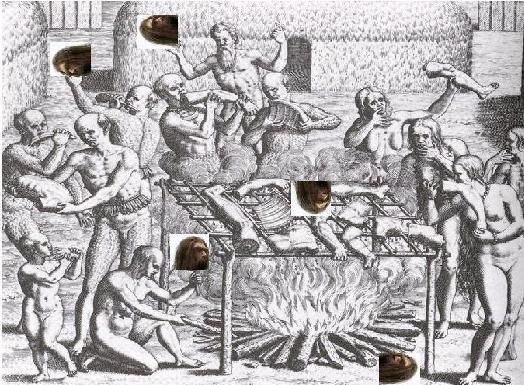
Fig. 2 |

| Aaaah! These Neanderthal toes are finger-licking good! You should try them, Joe! |

| Anyone want to trade a hairy leg for a hairy head? |

| Aaawwh, man! I hate ribs! Here, John! You eat the rest of it! |
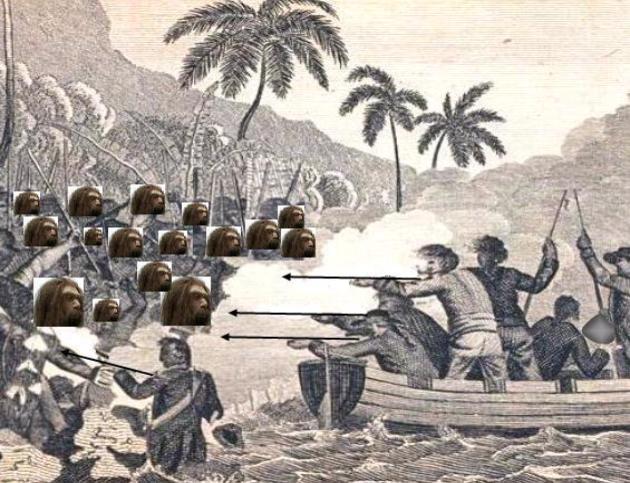
| D-Day (40,000 B.C.) The invasion begins |
| Superior technology and military strategy did away with the Neanderthals |
- Module main page: Background Extinctions: How did Neanderthal and Woolly wither away?
Pages in this module:
- 1. The differences between a paleontologist and an anthropologist
2. Stringer: The mighty hunter that caught a cold
3. This page:
Tattersall and Diamond: The Great Neanderthal-CroMagnon World War (40,000 - 25,000 B.C.)
4. Trinkaus and Wolpoff: How two top predators 'did it.'
5. Klein: Education is not what it used to be
6. Graham, MacPhee and Martin: Woolly got cold feet
7. So then, how did Neanderthal and Woolly disappear?
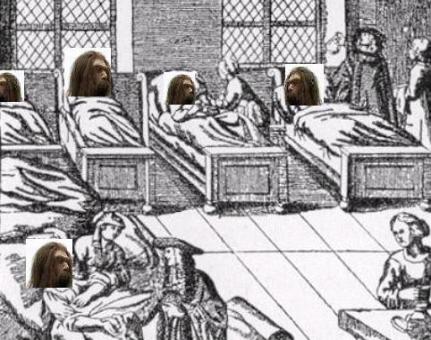
The spoils of war |
Taking good care of Neanderthal
- ________________________________________________________________________________________
- Copyright © by Nila Gaede 2008