1.0 The multi-dimensional sphere of Mathematics
If you ask a 4th Grader how many dimensions a sphere has, he will instantly reply that it has three: length, width, and
height. Nothing to it!
Don’t ever even think about asking the same question to a grown up mathematician. The answer will take several hours
and still they won't agree:
1. a relativist (the 1-D sphere):
- “ A one-dimensional complex manifold” [1]
2. a topologist (the 2-D sphere):
- “ topologists refer to it as the 2-sphere and denote it S2.” [2]
3. a geometer (the 3-D sphere):
- “ geometers call the surface of the usual sphere the 3-sphere” [3]
- “ geometers and topologists adopt incompatible conventions for the meaning
of ‘n-sphere,’ with geometers referring to the number of coordinates in the
underlying space (‘thus a two-dimensional sphere is a circle,’ Coxeter 1973,
p. 125) and topologists referring to the dimension of the surface itself” [4]
“ Although physicists often use the term ‘sphere’ to mean the solid ball,
mathematicians definitely do not!” [5]
4. or another relativist (the 4-D sphere):
- “ The n-hypersphere (often simply called the n-sphere) is a generalization of the
circle (called by geometers the 2-sphere) and usual sphere (called by geometers
the 3-sphere) to dimensions n≥4.” [6]
- And if the sphere also rings like a bell and smells like camel poop, following the specifications of the mathematicians,
you end up with a 6-D sphere:
- “ dimensions can also be other physical parameters such as the mass and electric
charge of an object, or even, in a context where cost is relevant, an economic
parameter such as its price.” [7]
Of course, if after 3000 years, the idiots of Mathematical Physics still don’t know how many dimensions a sphere has, you
wonder how they can be so sure of their theories. How can they deal with higher level concepts if they still have yet to
master the fundamentals? It seems more likely that relativists chose this geometric figure to model their universe because
of its convenient ambiguity. If a sphere can have anywhere from 1 to 4 dimensions, the bozos can get away with anything
they say during the dissertation. Certainly, the mathematicians wouldn't be able to get away with their 2-D / 3-D dualities if
they invoked a cube. It is the malleable, unscientific definition of the word dimension of Mathematics which enables the
mathematical physicists to parry challenges to their ludicrous theories. The inconsistent use of the word dimension has a
lot to do with why space-time and strings are still around today. The problem, as always in Mathematical Physics, has its
roots in misconceived definitions and language.
2.0 The source of the problem: mathematical dimensions are really number lines
The mathematician begins his presentation by formally defining the word sphere:
- " In mathematics, a sphere is the set of all points in three-dimensional space (R3)
which are at distance r from a fixed point of that space, where r is a positive real
number called the radius of the sphere." [8]
- Next, the mathematician proceeds to violate this definition:
" The fixed point is called the center or centre, and is not part of the sphere itself." [8]
" a mathematical sphere is considered to be a two-dimensional spherical surface" [8]
- The mathematician invokes a center point to define it, but tells you that the center is not part of the sphere. This is like
saying that I need the tail to define a horse, but that the tail is not part of the horse. And then you wonder how its surface
can be two-dimensional if we just finished defining the sphere as:
- " the set of all points in three-dimensional space" [8]
" which are at distance r from a fixed point" [8]
What happened to the radius? Don't the idiots need the radius to specify any point on the surface of the sphere?
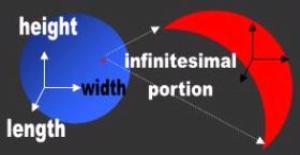
In Science, irrespective of how 'infinitesimal' the proponent wishes to make his dot, we require three 'mathematical
coordinates' to specify a point on the surface of a sphere (Fig. 1). These 'coordinates' are neither the familiar length,
width, and height of Physics nor the just as well known longitude, latitude, and altitude. We are talking neither about
dimensions nor coordinates. The 'coordinates' that relativists are referring to are actually number lines known as
parallels and meridians plus a third one that extends from the center of the circle to the surface and which is called
the radius:
“ the surface of a billiard ball is a two-dimensional curved space…’ (p. 69)
‘For two-dimensional inhabitants of this two-dimensional world the space is
infinite, or closed, but without boundaries. They are living on a spherical
two-dimensional space of radius R.” (p. 71) [9]
Indeed, cartographers invoke this 'radius' 'coordinate' when they discuss geocentric latitude. [10] Why the
mathematicians leave the radius out of their descriptions is still, unfortunately, an unsolved problem in Psychiatry.
Perhaps they take it for granted because it is the same magnitude for all points on the surface. Who knows?
The mathematician now clarifies that he was referring to non-dimensional locations on the surface and not to physical
dots and surfaces.
But pursuant to his own definition, we still require three 'coordinates' to build every point on his abstract surface! We
need parallel, meridian, and radius for every 0-D 'dot' no matter what! The mathematicians require an ordered
triplet (x, y, z) to mathematically specify ANY location on the surface of a sphere. Of course, if the mathematicians were
to include the radius, they would no longer be able to get away with telling you that a sphere or its surface is 2-D.
Fig. 1 In Science, both a sphere and any portion of its surface are three dimensional (3-D)! |
Therefore, the problem with the idiotic mathematical definition of the word sphere is that it is unscientific. It is unscientific
because it cannot be used consistently in a dissertation. Specifically, the mathematician invokes the center point and the
radius to define the sphere and then wants you to forget about both of them. Actually, the mathematicians are not defining
a sphere. They are defining how to locate something on its surface. This is not WHAT a sphere IS. This is also NOT a
description of a sphere.
The term 'two-dimensional' that the mathematicians use to qualify their sphere is grossly misleading. They are NOT using
the term 'dimension' in the same way sane human beings use and understand the word dimension. When you say that a
house is three-dimensional, you are not talking about how many parameters you need to specify a point on the house. If
this were so and you decide to include the time of day, the house would be four-dimensional (3 spatial + 1 temporal
'dimension') simply because you needed four numbers to specify the given point. No. When you say the house is 3-D you
are saying that it has length, width, and height. All objects that exist are 3-D in this and ONLY in this sense. A sphere is a
solid. Any infinitesimal portion of its surface is 3-D. This is not a question of measurement. This is a conceptual issue.
The mathematicians are talking about something else which, as it turns out, does not involve the center of the sphere.
The mathematicians are alluding to geodesics: motion along the surface of a sphere. The mathematicians are not only
NOT referring to the bowling ball itself, they are not even referring to its surface or to how to locate one point on this
surface. The mathematicians are dealing with something unrelated to the sphere itself. In order to locate a point, meaning
a location of an object moving along the surface of the sphere at a specified time, they just need two 'coordinates':
longitude and latitude. They look at the object's starting point and measure to where it is now. They are interested in
calculating its 'position' on the sphere. This is what they are alluding to when they say that the surface of a sphere IS
2-D. That's how the mathematicians have done away with both the center point and the radius.
By now the mathematical definition of the word sphere is three orders removed from logic. The mathematicians are not
talking about the sphere, and they're not talking about dimensions or coordinates. They are talking strictly about number
lines: a pair of axes that define the location of an extrinsic object running along the sphere. As it turns out, this object is
not really an object, but rather the location of that object. The mathematicians magically make this location coincide with
a location comprising the surface of the sphere. The mathematicians have in effect constructed the entire surface of their
sphere with dynamic locations. These locations move around and trace geodesics. This is the idiocy that the
mathematicians claim is '2-D' and has something to do with Physics.
3.0 So what?
The mathematician may argue that none of these arguments are fatal to his discipline. So what if he has several definitions
and uses them in specific situations?
The problem is that the mathematical physicists routinely extrapolate the conclusions they derive in their irrational world
of Math to Physics. When a mathematician offers a physical interpretation to his equations, he glosses over the
irreconcilable differences between the mathematical sphere and the sphere of Physics. He treats them as synonyms. He
alludes to the sphere of Physics, but talks about the conclusions of Mathematics.
One prominent example is the myth that a geodesic is the shortest route from Point A to Point B on a sphere. You tell the
mathematician that a shorter route is through the interior of the sphere. The mathematician tells you that you can't go from
Tokyo to Buenos Aires through the Earth. You must go around it. But this argument is absolute bunk in our present
context! The mathematician defined his sphere as a hollow balloon. What justification does he have to deny you passage
through its interior? The mathematician has momentarily and self-servingly switched from the hollow sphere of Math to the
compact sphere of Physics just to win the discussion. Another example, is space-time. The mathematician illustrates and
describes an inflating balloon but incongruously tells you that it is unimaginable. What do you mean it is unimaginable? I'm
staring right at it! What is it that you can't imagine about it, you stupid relativist?
It is this inconsistent usage, this back and forth between Math and Physics, specifically between mathematical and
physical dimensions, which prevents anyone from understanding a mathematician or challenging his theories.

| Hang on tight, guys! A two-dimensional sphere has no power to contain me. I'm 3D! |
| In Math, a sphere may also be 1-D and 4-D |
| Adapted for the Internet from: Why God Doesn't Exist |
- Module main page: A mathematician says that solids are hollow
Pages in this module:
- 2. This page: In Math, a sphere may also be 1-D and 4-D

- ________________________________________________________________________________________
- Copyright © by Nila Gaede 2008