| Adapted for the Internet from: Why God Doesn't Exist |
- 1. Relativistic semantics make for interesting circular discussions
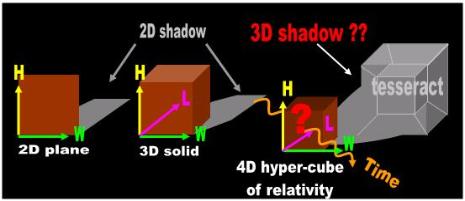
One version of the 4-D tesseract is that it projects a shadow onto our 3-D world that looks like the object that relativists illustrate
on their pages.
- “ Now let us take our three-dimensional cube and carry it, at right angles to itself,
through a fourth physical dimension: not left-right, not forward-back, not up-down,
but simultaneously at right angles to all those directions. I cannot show you what
direction that is, but I can imagine it to exist. In such a case, we would have generated
a four-dimensional hypercube, also called a tesseract. I cannot show you a tesseract,
because we are trapped in three dimensions. But what I can show you is the shadow
in three dimensions of a tesseract. It resembles two nested cubes, all the vertices
connected by lines. But for a real tesseract, in four dimensions, all the lines would be
of equal length and all the angles would be right angles.” (p. 264) [1]
“ light on a four-dimensional object would cast a three-dimensional shadow… if a
four-dimensional cube were lit "from above", its shadow would be that of a three-
dimensional cube within another three-dimensional cube.” [2]
“ What is a four dimensional shadow? When you hold a three-dimensional object over
a flat surface of a table you can see the two-dimensional shadow of that object on the
table… When you hold the ‘Geometrical Hypercube’ or look at it you are seeing the
world’s most unique three-dimensional shadow” [3]
- “ The figure on the left is a projection of the tesseract in three-space” [4]
Another version has it that the 3-D shadow itself is the genuine tesseract:
- “ a tesseract is in principle obtained by combining two cubes” [5]
“ The tesseract (Figure 6b) gives us what this author believes is the best avenue to
visualizing 4-D data. The eight bounding cubes can be identified: the large outer cube,
the smaller inner cube, and the six trapezoids that connect them. The relationships
between the cubes are visible as well. Each is surrounded by six others, and shares a
square face with each.” [6]
- This again confirms that relativists are not talking about an abstract concept. They are attempting to persuade you that they are
referring to a geometric figure. As far as we know, only physical objects have the ability to cast shadows. If you disagree, try
shedding light on love and see if you get a shadow.
- So, which is it? Will the real tesseract please stand up? Is the nested set of cubes relativists draw the 4-D object or merely the
shadow this object would cast in our 3-D world?
One fellow seems to have zeroed in on this problem and pointed it out:
“ There is some confusion in terms with respect to the labelling of four-dimensional
phenomena. The confusion centers around the four-dimensional analog of the cube.
There are basically two camps. The first camp uses the hyper- prefix for only the
fourth dimension, and the word ‘tesseract’ to refer to one of two things - either the
four-dimensional hypercube folded out into three-dimensional space, or to the
cube-inside-a-cube visualization of the four-dimensional hypercube. The second
camp uses the hyper- prefix to refer to any dimension above the third (and sometimes
to refer to any dimension), and ‘tesseract’ to refer to a four-dimensional hypercube.” [7]
No. It is not a confusion. It is called not knowing the scientific method. In Science, we must define and resolve the definitions and
the exhibits of the case before we can decide on the theory or before engaging in eternal discussions. We can't understand a
theory unless we first visualize the objects and understand the definitions. This writer zeroed in on a serious shortcoming he
finds in the literature, but glosses over it as if this were a trivial matter. He just casually points out that people are using the word
tesseract inconsistently and then proceeds as if nothing.
Unfortunately few have caught on. Mathematical physicists are notoriously slow in understanding anything that shows
contradictions in their theories. Nevertheless, in relativity it is best to leave things as ambiguous as possible so that anyone can
interpret anything they want according to their biases and predispositions. The worldly wisdom that has come out of the Einstein
and his ridiculous relativity legacy is and has been that ‘everything is relative,’ meaning that it’s just your opinion. This philosophy
is popular because it means that people can safely continue with their private religions. The greatest intelligence of all times says
so! This explains Einstein's popularity and why his relativity theory has been so successful. In relativity, you just can't go wrong.
So? Is the hypercube or tesseract (or whatever the idiots of Mathematics want to call it) a 3-D shadow or a 4-D object? Is the nested
set of cubes the 4-D object or the shadow this object would cast in our 3-D world?
Of course, if the tesseract is both a 4-D object and a 3-D shadow, it will be difficult for someone to challenge such a monster. How
can you falsify an irrational theory? How can you run an experiment if you cannot even visualize the object at the center of the
experiment (i.e., the 4-D hypercube)? How can you even design your experiment? All experiments and theories of relativity are
worthless if the proponents cannot even imagine what they are talking about. How do they intend to run an experiment or certify
the conclusions if they cannot even agree on the objects at the center of the inquiry? Relativity is an un-falsifiable theory because
no one has yet got the story straight. The tesseract is another example of how the mathematicians give lip service to definitions
and then proceed like bumbling fools.
| Relativists invented a 3-D shadow |
|
Relativists may attempt to redirect the argument and say that there is no reason they shouldn’t be able to build a 3-D shadow
with superimposed lights or holography. After all, the umbra and penumbra seem to be two shadows that we can distinguish
on the wall.
Should we conclude, then, that there are English-speaking rodents in real life because we can caricature a mouse and turn
Mickey into a cartoon? The shadow of a lonely object should not require multiple lights, but this collage nevertheless has to
do with manipulation of electromagnetic waves and not with an authentic object. The experiment would not prove that an object
called a hypercube exists. The juror can never verify that a genuine tesseract would cast such a shadow or that a 4-D object
would cast a tesseract-like shadow onto our 3-D world. The allegation would further leave unanswered substantial issues such
as whether a 4-D hypercube has an axis running at 90º to length, width, and height, or whether there is any point on a tesseract
whence I cannot trace a straight line to me. Is a hologram perchance equivalent to a solid?
Again, relativists have swallowed a whopping Emperor's Clothes tale! It is the 'star' mentality of Hollywood Physics that has left
the gullible idiots begging for Einstein's autograph. People are fascinated by big names and blindly follow authority.
The 4-D hypercube casting its 3-D shadow |
2. One 'test' for a physical object is that it must cast a shadow
But semantics aside, a shadow would seem to be the minimum test required of such an object. If we can project a sphere
onto a 2-D surface, there should be no reason why we can't project the 4-D hypersphere onto a 3-D screen or box. Indeed,
a shadow would seem to be the minimum test required of such an object. If we can project a sphere onto a 2-D surface,
there should be no reason why we can't project the 4-D hypersphere onto a 3-D screen or box.
The trouble with the hypercube's shadow, however, is that we can see its internal structure. Our experience with shadows,
on the other hand, is that they come in single, 2-D flavors and without the fine detail of the object projecting it (Fig. 1).
Therefore, experiment fails to confirm this popular relativistic claim. Please list this as another ‘prediction’ of General Relativity
that turned out to be false. I like to keep count because relativists typically have extremely short attention spans and memories.
They ignorantly parrot what they heard from a self-proclaimed guru of relativity: that GR has been confirmed hundreds of times
and never been falsified.

| Uncle Steve's lost it again! And we ran out of schizo pills this morning! What a bummer! |
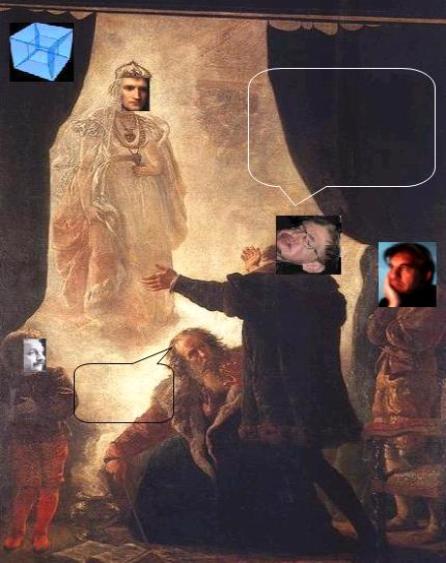
| I see the 4D spirit of the Virgin of the Tesseract. |
| Are you sure, man? |
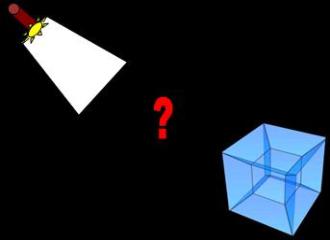
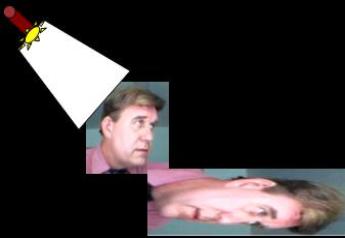
Fig. 1 The shadow never lies: A shadow within a shadow |
this unidentified 4-D object as a geometric figure and not as an abstract concept comparable to
love or justice. However, we know of no shadow that is 3-D (i.e., an object), and the idiot who
thinks of a hologram should study the definition of object some more. Relativists perennially go
back and forth between objects and concepts to push their theories through. That's why it's
important to define these two words before engaging in circular discussion with them.
love or justice. However, we know of no shadow that is 3-D (i.e., an object), and the idiot who
thinks of a hologram should study the definition of object some more. Relativists perennially go
back and forth between objects and concepts to push their theories through. That's why it's
important to define these two words before engaging in circular discussion with them.
- This module: GR's 3-D Tesseract
- Pages in this module:
- 1. Relativists explain geometric figures
2. This page: Relativists haven't decided whether a tesseract is a 4-D figure or its 3-D shadow
3. Relativists say that you are too stupid to see a tesseract with your eyes
4. What really is a tesseract?

- ________________________________________________________________________________________
- Copyright © by Nila Gaede 2008