| Adapted for the Internet from: Why God Doesn't Exist |
| GR's 3-D flatlander |
- 1.0 The misconceived Flatlander analogy of Relativity
In an analogy related to Riemann’s Triangle, Ferris has what he claims is a 2-D Flatlander walking in a ‘straight line’ along the
alleged 2-D ‘surface’ of a sphere. (p. 202) [1] If the Universe were an infinite plane, the Flatlander would never arrive at his
starting point, but here he apparently does. Hence, the Flatlander concludes that his Universe is not infinite as inferred from
intuition, but finite as demonstrated by experiment. Incongruously, relativists claim that the Universe is also ‘unbounded’
because the Flatlander can go past his starting point eternally without encountering any obstacle.
Relativists now extrapolate this reasoning to the next dimension. If faster than light (FTL) technology enables a 3-D relativist
to travel in a straight line around space-time, he would eventually arrive at his starting point and rightfully conclude that the
relativistic, 4-D universe is closed (meaning finite). It follows that the Universe is also ‘unbounded’ since nothing prevents
him from walking around perpetually.
Thus, relativists ‘prove’ to the unwary novice how they are able to infer the shape of space-time through measurement and
'predict' its large scale structure by interpreting equations and functions. In other words, since the mathematicians are
unable to show you a mockup of space-time, they ‘explain’ this object to you step by step via analogy. For good measure,
they reinforce these arguments by drawing on the authority of Mathematics.
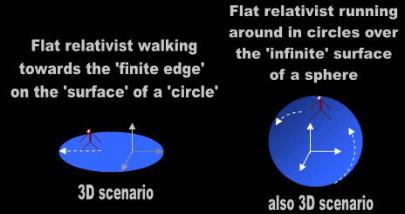
There is, however, a minor catch that may foil Ferris’s venture. By simply looking at the drawings even a child can discern
that each of his alleged 2-D figures is 3-D, including the thick ‘plane’ with which he begins his presentation. Indeed, when
Ferris molds his board into a sphere, he is oblivious to the fact that it encroaches upon a third dimension. And his palpably
3-D Flatlander stands vertically on this surface (Fig. 1)!A Flatlander walking perpendicular to a plane is by definition a 3-D
scenario. A Flatlander walking vertically over the surface of a sphere is also a 3-D scenario. Ferris is not describing Flatland.
He is describing Solid-land.
A more fundamental objection is that relativists do not have their language straight. For the purposes of Science, an adjective
can only be used in the context of physical objects. A genuine adverb may only be used in the context of motion. A sphere
can be said to be bounded, finite, or limited. Walking around a sphere cannot be said to be unbounded. Walking can at best
be incessant, perpetual, or constant. These words are adjectives for the purposes of ordinary speech. They are adverbs for
the purposes of Science.
The Flatlander analogy does not show that our Universe is 4D. It just shows that relativists don’t understand the difference
between an adjective and an adverb. A relativist is a bumbling fool who can't tell the difference between a genuine noun
(an object) and a genuine verb (a concept).
Fig. 1 Lost in Flatland |
| A Flatlander walking perpendicular to a plane is by definition a 3-D scenario. A Flatlander walking vertically over the surface of a sphere is also a 3-D scenario. The Flatlander analogy does not show that our Universe is 4D. It just shows that relativists don’t under-stand the difference between an adjective (bounded sphere) and an adverb (incessantly walking around the bounded sphere). |

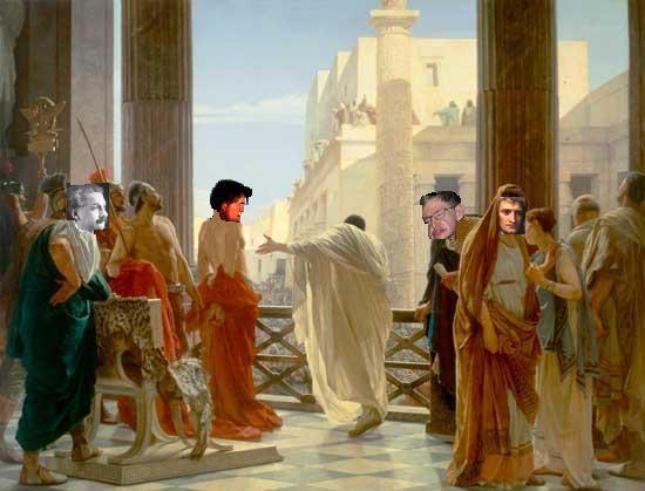
| Well, Bill got a little too cocky and told the royal mathematicians that he didn't really know what they meant by bounded and unbounded. So the magistrate bound and gagged him. I suspect that tomorrow Bill will run unboundedly around the Colosseum with the lions. |
2.0 The punch line: idiot-talk of relativity
Relativists routinely talk about 'space-like' and 'time-like' events, usually in the context of the Holy Cone, an image
worshipped by the fundamentalists of this religion:
- " A Time-like event is one in which there is an observer who observes two events
occur at different times but at the same point in space." [2]
- " The interval AC in the diagram is 'space-like'; i.e., there is a frame of reference in
which event A and event C occur simultaneously, separated only in space." [3]
[A mathematician is an individual who superimposes a movie on a photograph,
calls this surrealistic collage an 'inertial frame', and claims to be doing Physics!]
" causality is simply a convention where we use the term ‘cause’ to label the earlier
and ‘effect’ to label the later of two correlated events. However this convention is
inappropriate because the time ordering of space like events are dependent on the
inertial frame. SR, as applied to space-like events, which are correlated, appears to
demand that causality go in both time directions." [4]
" At the other extreme, when the speed is that of light itself, P then lies on the light
cone; and we find s = 0. The light cone is precisely the set of points whose
Minkowskian 'distance' (i.e. 'time') from O is actually zero. Thus, a photon would
not 'experience' any passage of time at all!" (p. 197) [5]
[No kiddin, huh? I wonder why that is. I also wonder what it is that they teach in
those British schools nowadays]
" Th(SR) 'does not prohibit spacelike (faster-than-light) causation'. " [6]
- [I'm sorry. I suddenly came down with an FTL case of hemorrhoids. Will you please
excuse me?]
The idiots of Mathematics get these strange ideas from their insistence on modeling particle interactions with
space-time diagrams. For some strange reason, the time axis has direction and points north:
- " The time axis points upward and the space axis to the right... Particles are
represented by lines with arrows to denote the direction of their travel, with
antiparticles having their arrows reversed. " [7]
- "
None of these conventions agreed to by humans have anything to do with the real world. How does an
anti-particle (whatever that is) differ in shape from a 'normal' particle? How is the behavior of an anti-particle
(e.g., running backwards) related to its shape?
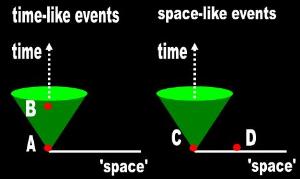
The infamous 'space-like' event of Mathematics is what in Physics is called a photograph. The two objects are
sitting in a single field of view or cross-section of time (Fig. 2). Hence, it is not surprising that a photon does not
experience any passage of time. And yes, space-like 'causation' is usually faster-than-light because, for unknown
reasons, it tends to be instantaneous. In Physics, it is very difficult to get the tree to travel slower than the mountain
within the same photograph.
Again, the idiots of Mathematics get confused because they define the crucial word 'event' as 'a point is space-time.'
So then they get more confused because they visualize these locations as dots and tell you that space-time is
quantized, meaning that our Universe is comprised of countless minuscule points. Space-time is so grainy that the
surface ends up being continuous. If you ask the numskulls what shape these dots have, they will tell you that they
don't know because the dots are infinitesimal. The idiot of Mathematics equates infinitesimal with zero-dimensional.
He is not smart enough to realize that the word infinitesimal means that the dot is 3-D and has greater than zero
diameter, size, etc.
It turns out that the idiots are not talking about dots or grains or anything related to architecture. They can't. I repeat:
Mathematics is exclusively a dynamic discipline. Architecture is always static. So what are the mathematicians talking
about?
The examples that the idiots offer for an event shows that these are not points or dots, but occurrences, happenings,
verbs. The idiots have synthesized their dynamic 'events' into a single frame of the movie. They call this verb a 'point.'
The examples they give shows what kind of morons the mathematicians of the world really are:
- “ a pulse of light” (p. 24), “What happens at such events… For example, if the sun
were to cease to shine at this very moment” (p. 27, Fig. 2.5); [8]
“ a flash of a spark.” (p. 149); [9]
“ a car collision.” (p. 66); [10]
“ the explosion of a star or the single beat of a drum.” [11]
All these 'points' without exception take up a minimum of two frames in the film. The infamous 'point' of Mathematics
has length, width, height, and motion (time). In the language of Mathematical Physics, the infamous event is 4-D!
A time-like event is what we call a movie. No objects may occupy the same location because everything in the Universe
moved. No object can be in that frame of the film ever again. But the real problem with the time-like event is that the
birdbrains are not talking about distance. They are talking about distance-traveled. Thus, the idiots of relativity are
comparing the genuine 'space-like' distance of Physics against the phony 'time-like' distance-traveled of Mathematics.
And I have not told you yet that in order to arrive at all this poppycock, Einstein's followers had to replace the static
dimension of height with the dynamic number line known as time. But that's a story for another day!
Fig. 2 High level Math |
| In relativity they have developed very high level, sophisticated mathematical concepts known as space-like and time-like events, which are probably over your head. I venture to say that half the people don't understand what this stuff is about (and I'm only talking about relativists). But it's really not so bad. Allow me to give you a crash course... |
| As always, the mathematicians compare apples and oranges and make things much more complicated than necessary. A space-like 'event' is really not an event. For the purposes of science, an event (i.e., motion) takes up two or more locations of an object. For instance, the explosion of a star [12], the single beat of a drum [13], a pulse of light, (p. 24) [14], the sun ceasing to shine (p. 27, Fig. 2.5) [15], a car collision (p.66) [16], a flash of a spark (p 149) [17], and all other examples that the idiots of Mathematics use to illustrate their relativistic 'events' without exception take up no less than two frames in a film. A space-like 'event' is what is known as a photograph. When Old Man Universe takes a picture, no two physical objects may occupy the same location. A time-like event is a genuine event: a movie. In Physics, two objects may not occupy the same location because matter doesn't stand still. Every atom changes location in every frame of the Universal Movie. No two frames of the Cosmic Film are alike. In the foregoing illustration, we see dot A behind dot B in the film. This means that A is in a frame of the film closer to the happy ending of the video tape. A and B are not separated by distance as alleged by the numskulls of relativity. They are separated by distance-traveled. Dots C and D, on the other hand, share the same frame of the film. Thus, C does not temporally precede D or vice versa. The reason for this has nothing to do with the inability of our mathematicians to measure infinitesimal intervals. It has to do solely with the fact that C and D are in the same photograph. |
- Module main page: Analogies are for laymen?
- Pages in this module:

- ________________________________________________________________________________________
- Copyright © by Nila Gaede 2008