| Adapted for the Internet from: Why God Doesn't Exist |
| What really is a dimension? |
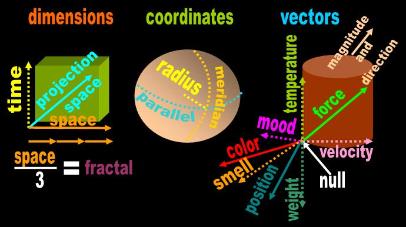
- The following points synthesize some of the differences between dimensions, coordinates, vectors, and
number lines:
• From a conceptual point of view, a dimension and a coordinate are drawn with a solid line.
- They represent static concepts. A vector and a number line, on the other hand, consist of
segmented lines
• A dimension and a coordinate are static concepts. They are photographs, still images. A
- vector and a number line are dynamic concepts. They are movies, a series of frames.
• A dimension, a coordinate and a vector have direction. A number line does not.
• A dimension and a coordinate are continuous (made of a single piece). A vector and a
- number line are necessarily made of parts.
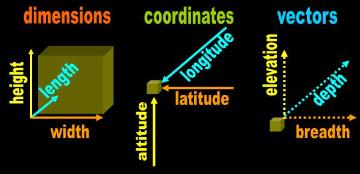
• The three dimensions are length, width, and height; the three coordinates are known
- as longitude, latitude, and altitude; the three vectors are known as depth, breadth,
and elevation. The names of the three number lines are parallel, meridian, and either
radius or diameter (in the case of circular and spherical objects). We have no name for
the third leg of straight edge solids. We can just as well call it radius or diameter to
distinguish it from qualitative height, altitude, and elevation.
• Number lines are a measure of distance traveled, of how many steps we need to get
- somewhere, or how many frames a film has. An ordered pair symbolically depicts two
number lines.
• Dimensions, coordinates, and vectors have two properties: direction and orthogonality.
- Length runs at 90˚ to width and to height. Number lines don't run at 90˚ to anything.
We can place number lines in any direction. Direction is not a feature of number lines.
It can't be because, for the purposes of a scientific discussion, a moving object cannot
have direction. Direction is a static concept. Direction has to do with orientation and tilt
and not with displacement. It may apply only for a given location of an object. For example,
we can say that the Moon is moving in the direction the Andromeda Galaxy. But this
statement belongs squarely within ordinary speech. The next frame of the film of the
Moons orbit shows the Moon moving to the side of Andromeda and so on down the line.
The Moon can be said to be moving along a line of direction leading to Andromeda only if
we assume that for the next few frames it continues traveling parallel to a straight line
leading to Andromeda. We trace an imaginary straight line from the Moon to Andromeda
and assume that the Moon will travel along this route.
For the purposes of Physics, the term three-dimensional (3-D) means that three hypothetical mutually-
perpendicular planes of an object can be brought together to form a corner while their edges meet to form
a vertex. We call these edges – which are typically regarded as lines – dimensions.
- three-dimensional (adj.): A word used to qualify an object that contains a vertex or corner.
We see objects in 2-D. In order to see in 3-D, we would have to have another eye or set of eyes to see the
same object from a lateral perspective. With holography we are able to perceive an object in 3-D, but what is
really in front of us is a 2-D image with different shades, tones, and colors of light. Nevertheless, an object is
not 3-D because the observer visualizes it as such (proof). An object is 3-D if it points or faces in three mutually
perpendicular directions on its own (i.e., by definition). A hologram is not a standalone physical object, but
rather the projection of images much like what you see on a movie screen. Hence, a hologram is not 3-D
because it is not a physical object. A hologram is entirely dependent on observers. A hologram is nothing
but a 3D shadow.
Note that the definition of the term three-dimensional precedes that of dimension. One reason for this is
historical. Our ancestors started out with real objects and only later developed abstract concepts such as
plane and line. Since all objects are three-dimensional, this seems like a natural starting point. An even more
important reason is that dimensions have two properties, facing and orthogonality, both of which are
qualitative. Facing stands alone, but not orthogonality. This attribute requires either implicit or explicit
referencing to another dimension. All by itself, a dimension is just a line that has direction (one end compared
to the other). A direction graduates to a dimension only when it lies perpendicular to at least one of her sisters.
Each of the dimensions faces orthogonally away from the other two. Width is naught without length or height!
This converts the right angle into a sine qua non feature of the definition. Edge-land is not even a figment of the
imagination: you cannot conceived of a standalone 1-D! When we use the word width to label a conceptually
one-dimensional edge we are tacitly referencing this width to either the length or the height of the object the
edge forms a part of. As a standalone concept, width has no meaning, and any object we are capable of
visualizing is at least 2-D: width and height. Like its sine qua non properties -- facing and orthogonal --
dimensions are qualitative relations that belong exclusively to Physics. Mathematics has no business using
length, width, and height.
The names of the only three dimensions known to rational humans are length, width, and height. The
convention is that height is aligned parallel to the direction of gravity of the celestial body used as reference
and width with the observer’s horizon. The word dimension (singular) refers to one of these straight lines and
should not be confused with the words coordinate or vector. A dimension is an attribute of a single physical
object. A coordinate is used to qualitatively determine the location of our test object with respect to extrinsic
reference points. A vector is used to represent the displacement of a single object. Hence, each of these terms
has radically different meanings and connotations in Physics. The mathematicians routinely confuse all three
and take them for synonyms: magnitude and direction.
The relativist may comment now that, colloquially, we qualify the width of a box as being or having '5 meters'.
How can I then say that a dimension is exclusively qualitative?
The vernacular treats width as a noun because the word momentarily happens to be the subject of the
sentence. Hence, in the expression '5 meter width', 5 is an adverb, meter is an adjective, and width acts as
a noun. In Physics, however, width is always an adjective: an attribute of an object. The qualitative, directional
concept width is implicitly referenced to the length and/or height of the box. Width cannot just point in any
arbitrary direction, but implies a definitional relation with at least one of the other two dimensions. The quantity
5 meters, instead, is gauged against an extrinsic, pre-established standard: the meter. If the box and you are the
sole objects in the Universe, the box is immediately identified as 3-dimensional, but you could say nothing yet
of the magnitude of 'the width' of the box until you establish a standard and then compare this specific side of
the box with the standard.
Moreover, width is conceptually continuous whereas numbers are conceptually discrete. By using the
magnitude 5 and the unit meter, we are in effect chopping up an indivisible direction called width into little
pieces. The mathematician is not talking about a continuous dimension, but about a segmented number line,
an axis which he unwittingly places parallel to a particular side of the box and which he mistakenly calls width.
This again shows that the vernacular of Mathematics is unsatisfactory as a substitute language for Physics.
The devil's advocate may now step in and say that under these circumstances we can nevertheless tell that the
height of the box is twice that of the width, an apparently quantitative relation inherent in the box.
However, in order to determine this he inadvertently converted width into a standard and imagined this now
extrinsic standard parallel to height. Comparisons involve observers and motion, and magnitudes such as
'twice' invoke extrinsic objects. A cube is structurally different than a rectangular box in the absence of
observers or Math. The right angle, on the other hand, is not quantitative because we are not asked to compare
it against the direction of another dimension to verify whether it is indeed 90°. Width is by definition
perpendicular to the height and length of the test object under study. To qualify an object as 3-D implies that for
the remainder of the presentation the object will be deemed to have at least one vertex.
As a final note, an object that contains a 3-D object is itself a 3-D object. This need not be proven by theorem
either. It follows from the definition. Hence, a sphere is 3-D because it contains a 3-D cube ( a vertex) and not
because we can locate a point on its surface with a given number of coordinates.
SCIENCE versus RELIGION |

| You take me for a fool? Longitude is not the same as width. It says so right here in my elementary textbook of Physics. |
| Fig. 3 Dimensions, coordinates, and vectors of Physics |
| Fig. 4 Dimensions, coordinates, and vectors of Mathematical Physics |
| The dimensions, coordinates, and vectors of Mathematics cannot be used consistently. They belong exclusively to religion. |
| The dimensions, coordinates, and vectors of Physics can be used consistently in a scientific presentation. |
Fig. 1 |
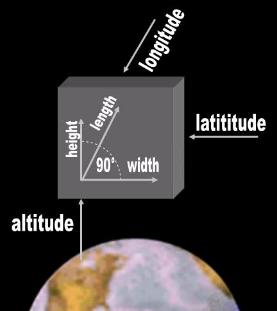
Fig. 2 |
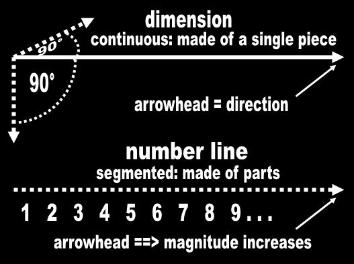
| In Physics, a dimension is conceptually made of a single piece (direction) and is nothing without the other two (orthogonality is a requirement). We tentatively draw a solid line to reflect this In Math, they have no use for dimensions. They use number lines which the idiots of Mathematics call dimensions and later attempt to relate to physical dimensions in their dissertations. The number line of Math has no direction (it is a segmented concept). It only has magnitude. Thus, we tentatively illustrate a number line with a dashed arrow. the arrowhead does not indicate direction. It indicates that numbers increase. |
Module home page: The mathematical definition of dimension is unscientific
- Pages in this module:
- 9. This page: What really is a dimension?
A dimension differs from a coordinate in
that the arrowhead points or faces away
from the object. The arrowhead of a
coordinate points toward the object.
that the arrowhead points or faces away
from the object. The arrowhead of a
coordinate points toward the object.

- ________________________________________________________________________________________
- Copyright © by Nila Gaede 2008